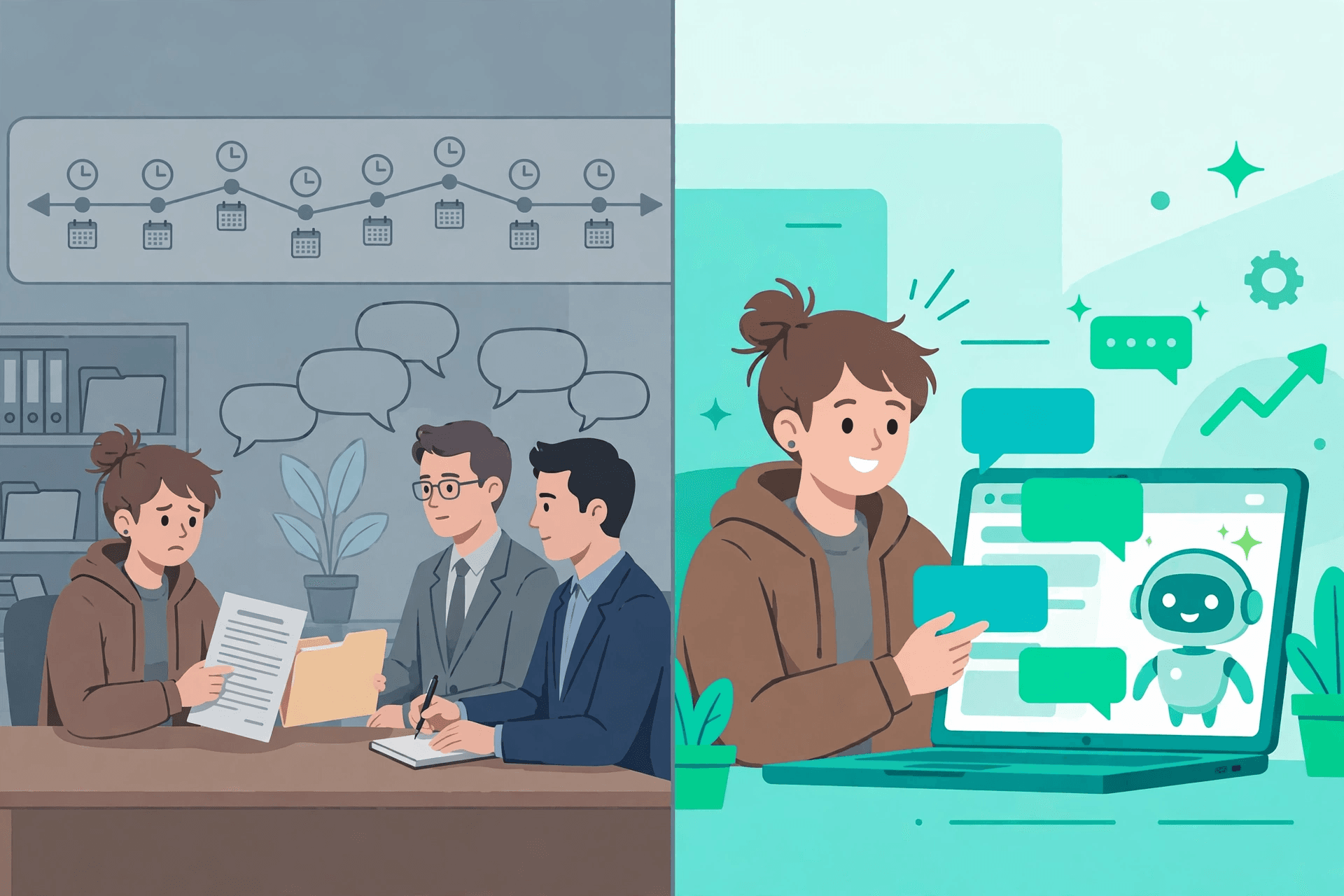
No-code vs agency chatbot build is the decision a small business faces when it knows it needs a chatbot but does not know who should build it. One route is to hire an agency: a team that takes the brief, designs the conversations, builds the bot, and hands it over. The other is to build it yourself on a no-code platform: connect the number, upload your documents, and answer customers the same day. Both routes end with a chatbot answering customers. They differ in almost everything else — who does the work, who owns the result, how long it takes to change anything, and what happens the day the relationship ends. This article works through the agency route the way a buyer experiences it: what the project actually buys, how it runs week by week, how to read the quote, the ownership questions to ask before signing, and the decision rule that settles which route fits your business.
What hiring an agency actually buys
An agency sells you a project, not a product. The project usually has four parts, and the proposal should name all four — if it does not, that is the first thing to ask about. First comes discovery: the agency interviews you, maps your customer questions, and writes a conversation design — which questions the bot answers, which ones it hands to a human, and what it says when it does not know. Second comes the build: the bot itself, connected to your WhatsApp number or website, trained on the material you supplied. Third is the handover: training for your team, documentation of what was built, and a period where the agency fixes what breaks. Fourth is the retainer: the monthly arrangement that keeps the bot working after handover — updates when your prices change, fixes when WhatsApp changes its rules, and new answers when customers ask new questions.
What you are really buying is somebody else's time and judgment. The agency brings experience you do not have: they have built bots before, they know which conversation designs fail, and they can spot the questions your customers will ask that you have not thought of. For a business whose chatbot needs to do something unusual — a deep integration with a booking system, a multi-step qualification flow, a bot that must talk to your own software — that judgment is worth paying for. For a business whose chatbot needs to answer the same routine questions every other business answers — opening hours, prices, availability, directions — the agency is selling you a project for a problem a platform already solved. The honest question is not whether the agency is good at its job. It is whether your chatbot needs a project at all.
How an agency project runs, week by week
The shape of an agency project is the same almost everywhere, and knowing it in advance is what keeps the buyer in control. It starts with a scoping call, where the agency asks what the bot should do and you discover — usually together — that the brief you walked in with is not the brief you need. Then comes the proposal: scope, timeline, and price, often with a discovery phase billed separately before the build is even quoted. Then the build itself, which runs in rounds: the agency shows you a version, you give feedback, they revise, and each round takes days. Then testing, where your team tries to break the bot with the questions real customers ask. Then launch, which is rarely the end — the first month after launch is when the bot meets the questions nobody predicted, and the fixes in that month decide whether customers trust it.
The timeline is the part buyers underestimate most. A no-code build is measured in hours: connect the number, upload the documents, test it with your own questions, go live. An agency build is measured in weeks, and the weeks are not mostly building — they are waiting. Waiting for the discovery call, waiting for the proposal, waiting for the next round of revisions, waiting for the agency's next available slot when your prices change. None of that waiting is the agency's fault; it is the nature of a project with two organisations in it. But it is a real cost, and it falls on the business whose customers are messaging now, not next quarter. If your customers need answers this week, the agency's timeline is the decision, whatever the proposal says about quality.
The no-code route, step by step, is covered in the setup guide, and the question of what a custom build costs in the long run in the no-code vs custom build comparison.
How to read an agency quote
An agency quote is a document that rewards slow reading, because the price on the first page is rarely the price of the whole engagement. Read it in four parts. The build fee is the one-off cost of the project itself — discovery, design, build, testing, launch. The platform costs are the recurring charges underneath it: the WhatsApp API fees, the hosting, the AI model usage, the platform the agency built on. The retainer is the monthly cost of keeping the bot alive after launch — updates, fixes, new answers. And the change charges are what it costs when you want something different later: a new product line, a changed price list, a new language. A quote that shows only the build fee is not a complete quote; it is the first instalment of a relationship.
- Ask what is not in the build fee. If the discovery phase, the testing, or the first month of fixes are billed separately, the headline price is not the project price.
- Ask how changes are charged after launch. A bot that answers from your documents changes when you edit a document; a bot built by an agency changes when you raise a ticket, wait for a slot, and pay for the change.
- Ask what happens when WhatsApp changes its rules. Template approvals, policy updates, and API changes arrive regularly — find out whether the retainer covers them or whether each one is a new invoice.
- Ask for the exit in writing. The quote should say what you own, what you get if the relationship ends, and what it costs to move the bot somewhere else — before you sign, not after.
- Ask who answers when it breaks. A named person with a response time is a support arrangement; a generic support email with no commitment is a hope.
None of these questions is hostile, and a good agency will welcome them — agencies that have done this before expect a buyer to ask. An agency that treats the questions as difficult is telling you something about the relationship you are about to enter. The quote is also the moment to compare like with like: the agency's total first-year cost — build fee plus retainer plus platform costs — against a no-code platform's monthly plan for the same period. The comparison that matters is not the build fee against the monthly plan; it is the whole year against the whole year, including the changes you will inevitably need.
The ownership questions to ask before signing
Ownership is where agency engagements most often go wrong, and it goes wrong quietly — nothing breaks until the day you want to leave, and then everything breaks at once. There are four things to own, and the contract should name each one. The conversation design: the map of questions, answers, and handover rules the agency wrote for you. The knowledge base: the documents, answers, and training material the bot runs on — including anything the agency wrote on your behalf. The accounts: the WhatsApp number, the API access, and the platform account the bot lives in. And the data: the conversations the bot has had with your customers, and the record of what it promised them.
The test is simple: if the agency closed tomorrow, could your business keep answering customers? If the answer is no — if the bot lives in the agency's account, on the agency's platform, trained on documents only the agency holds — then you do not own a chatbot. You rent one, and the rent is the retainer. That is not necessarily a bad arrangement; plenty of businesses rent things they do not want to maintain. But it should be a conscious choice, priced as a rental, not discovered as a surprise. On a no-code platform the ownership is the opposite by default: your number, your account, your documents, your conversation history — the platform is a tool you use, not a landlord you depend on. The agency route can match that, but only if the contract says so before the build starts.
Illustrative example: a clinic weighing both routes
Take a small clinic — the figures below are illustrative, for the method only; replace them with your own numbers before deciding anything. Suppose the clinic's patients message with the same questions every day: opening hours, appointment availability, preparation instructions, and directions. Suppose the clinic asks an agency for a quote, and the quote has a build fee, a monthly retainer, and platform costs underneath. Suppose the clinic also tries the no-code route for an afternoon: connect the number, upload the price list and the preparation instructions, and let the agent answer the routine half while the receptionist keeps the rest. Suppose the afternoon test answers the same questions the agency's bot would answer — because the knowledge is the same, and the model is the same. The clinic's real choice is then not about quality of answers. It is about whether it wants to pay a project fee and a retainer for a bot it could run itself, or whether it would rather spend that money on the thing only a human can do: the patients who need a person. Run it with your own message volume and your own questions; the answer flips with complexity, and that is the point.
What each route gives you that the other cannot
The agency route's real strength is judgment on a hard problem. If your chatbot must do something no platform offers — a deep integration with your own systems, a qualification flow that branches on live data, a bot that is genuinely part of your product — an agency's experience is the shortest path to a working answer. The agency also absorbs the work: your team does not learn a new tool, does not write the conversation design, does not test the edge cases. For a business with no one to spare, that absorption is the product. And an agency can be accountable in a way a platform cannot: a contract with a named team, a delivery date, and someone to call when it breaks.
The no-code route's real strength is the opposite: speed and control. The bot is live the day you build it, not the quarter the project finishes. Every change is yours to make, in minutes, by editing a document — a new price, a new product, a new policy — with no ticket, no wait, and no charge. The bot improves with your business instead of lagging behind it, because the person who knows the answer is the person who can change it. And the cost is a monthly plan, not a project fee plus a retainer, which means the experiment is cheap: try it on your own customers for a month and see how many messages it resolves before you spend anything serious. What no-code gives up is the agency's judgment on a genuinely hard problem — and for the routine questions most businesses actually get, that judgment is not the binding constraint.
The middle path: done-for-you, on your own account
The choice is not actually binary, and the middle path is the one buyers miss most often. Some no-code platforms offer a done-for-you onboarding: their team sets the bot up for you — connects the number, uploads your documents, writes the first answers, configures the handover — and then hands you the account. You get the agency's absorption of the setup work without the agency's project: the bot lives in your account, on your documents, under your control, and you can change it yourself from the first day. The setup help is a service; the bot is yours. That distinction is the whole point: the question is not who does the setup, it is who owns the result and who can change it afterwards.
Neksio's Scale plan works this way: done-for-you onboarding is included, and the bot runs in your own account on your own documents, with your own OpenAI key if you want it. The setup is done for you; the ownership is not taken from you. If the engagement you actually want is somebody to do the first week for you — not somebody to own the bot for a year — the middle path is the honest version of the agency route, at a platform's price.
The decision rule: match the route to the problem
The comparison settles fastest when you sort by what the chatbot has to do, rather than by who builds it.
- Routine questions, one channel, your own documents — opening hours, prices, availability, directions: no-code. An agency project for this is a project fee for a problem a platform already solved.
- No one on your team has an afternoon to spare, but you want to own the result: the done-for-you middle path. Somebody sets it up; you keep the account, the documents, and the ability to change it.
- A genuinely hard problem — a deep integration with your own systems, a bot that is part of your product: an agency. This is what agencies are for, and the project fee is the price of judgment you do not have in-house.
- Customers messaging now, answers needed this week: no-code. An agency's timeline is measured in weeks of waiting, and waiting is a cost your customers pay.
- You want to test whether a chatbot helps at all before committing: no-code, on a free plan. A month of real customer conversations is better evidence than any proposal.
- You already have an agency quote: read it against the four-part test above — build fee, platform costs, retainer, change charges — and ask the ownership questions before signing, not after.
What a no-code vs agency chatbot build costs on Neksio
On Neksio, the Free plan covers 100 AI replies a month on WhatsApp — enough to test the no-code route on your own customers before spending anything: connect the number, upload your documents, and see how many messages the agent resolves. Starter at $12.99 a month covers 5,000 replies, Growth at $16.99 a month covers 15,000 replies and adds Facebook and Instagram, and Scale at $29.99 a month is unlimited replies with your own key, plus done-for-you onboarding — the middle path, where the setup is done for you and the bot stays in your account. Every plan runs on the official WhatsApp API with a unified inbox for the humans behind the agent, and no plan needs code. Neksio answers the customers who message you, one conversation at a time — it is not a bulk or broadcast tool.
100 AI replies a month on WhatsApp, no credit card. Connect your number, upload your documents, and let the agent answer the routine half today — with handover built in. Full detail on the pricing page.
Frequently asked questions
- Should I hire an agency to build my chatbot or use a no-code platform?
- Use a no-code platform when the bot answers routine questions from your own documents — hours, prices, availability — because the knowledge is the same and the bot can be live today. Hire an agency when the bot must do something no platform offers, like a deep integration with your own systems. If what you really want is somebody to do the setup for you, the done-for-you middle path gives you that without giving up ownership.
- How much does an agency chatbot build cost?
- An agency engagement has four parts, and the quote should show all of them: the one-off build fee, the recurring platform costs underneath it, the monthly retainer after launch, and the charges for changes later. Compare the whole first year — build fee plus retainer plus platform costs — against a no-code platform's monthly plan for the same period, not the build fee against the monthly plan.
- Who owns the chatbot if an agency builds it?
- Only what the contract says you own. Ask for four things in writing before signing: the conversation design, the knowledge base, the accounts the bot lives in, and the customer conversation data. If the bot lives in the agency's account on documents only the agency holds, you are renting the bot, not owning it — and the retainer is the rent.
- How long does an agency chatbot build take?
- Weeks, and most of the time is waiting — for the discovery call, the proposal, each round of revisions, and the agency's next available slot when something changes. A no-code build is measured in hours: connect the number, upload your documents, test it with your own questions, and go live the same day. If your customers need answers this week, the timeline is the decision.
- What is the done-for-you middle path?
- A no-code platform's team sets the bot up for you — connects the number, uploads your documents, writes the first answers, configures handover — and then hands you the account. You get the agency's absorption of the setup work without the agency's project: the bot lives in your account, on your documents, and you can change it yourself from day one. On Neksio, done-for-you onboarding is included in the Scale plan at $29.99 a month.
- What does a no-code chatbot cost on Neksio?
- Free covers 100 AI replies a month on WhatsApp. Starter is $12.99 a month for 5,000 replies, Growth is $16.99 for 15,000 replies plus Facebook and Instagram, and Scale is $29.99 for unlimited replies with your own key and done-for-you onboarding. Every plan runs on the official WhatsApp API with a unified inbox, and Neksio is not a bulk or broadcast tool.