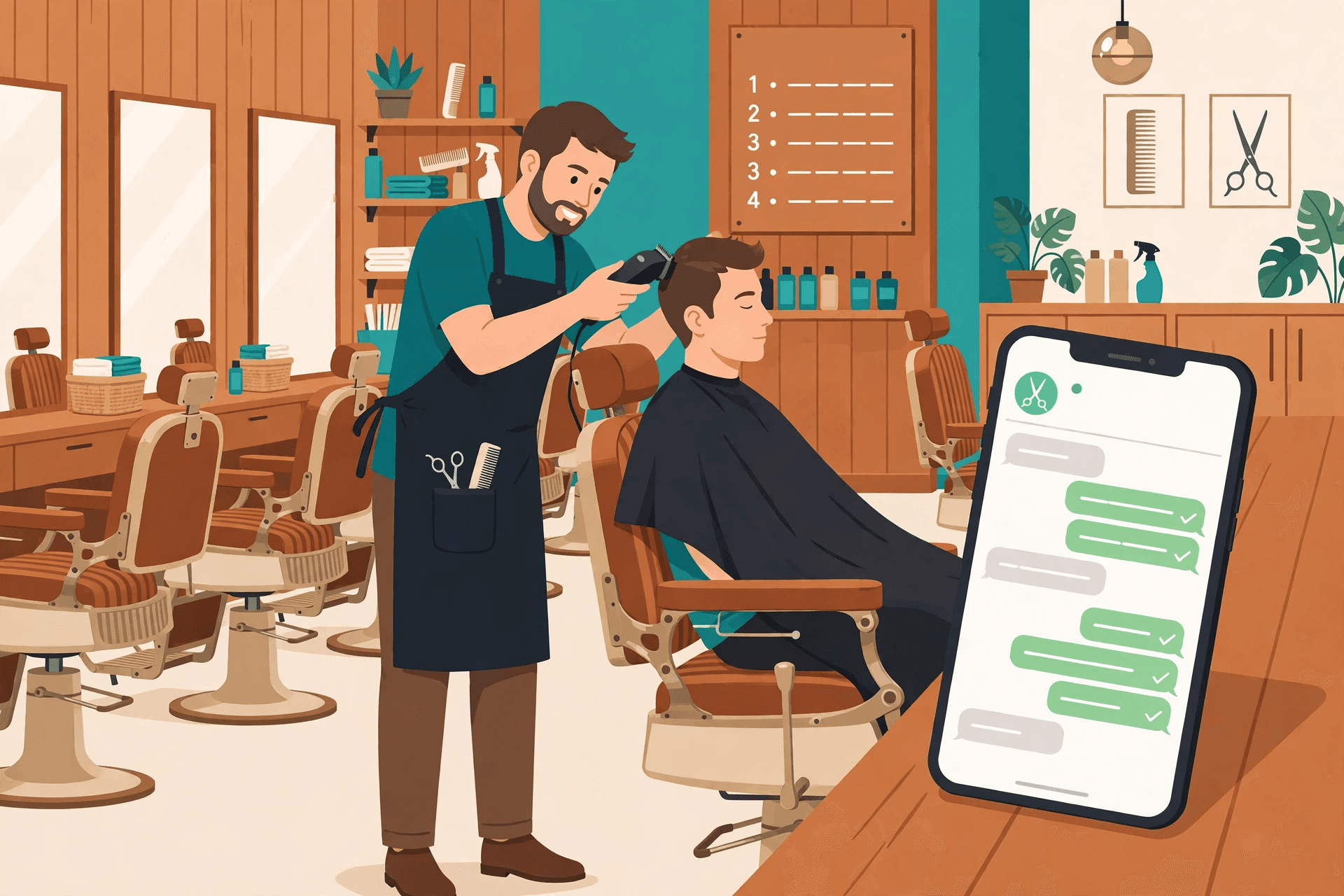
A WhatsApp chatbot for barbershops starts with the message every shop knows: “are you busy right now?” — sent at 9am on a Saturday by someone already in the car, from someone who will walk into whichever shop answers first. The sale depends on three answers the client needs before they will come: which barber is free, how long the wait is, and whether they can just turn up. A WhatsApp AI agent can run that conversation the moment it arrives: book the chair by the cut, put the walk-in in the queue with a real wait time, and hand the barber a book that is full before the doors open. This guide covers the barbershop side of it — the chair booked by cut, the walk-in queue, the regular who wants “the usual”, and the shop where several barbers each keep their own book — and the line the agent must not cross: it never quotes a price the shop has not set, and never promises a barber who is not working.
That line matters here because a barbershop runs on minutes, not days. A chair is a small, fast unit of income — a cut every half hour, a shave in between — and a booking made against the wrong duration throws the whole day out. The agent works from the shop's own documents — the cut list with times and prices, each barber's working days, the queue rules, the cancellation policy — and when it does not know, it says so and hands the conversation to a person. A shop that sets that rule up front gets the speed of instant replies without ever double-booking a chair or promising a barber who is off that day.
The chair: booked by cut, not by slot
A barbershop booking is not a generic appointment — the cut decides the time, and the time decides the day. A skin fade is not a beard trim, and a hot towel shave is not a kids' cut, and an agent that books them all into identical 30-minute slots will have the queue spilling out the door by noon. The agent's job is to book the chair for the cut, not just for the client.
- The cut list is the diary. Skin fade, taper, buzz cut, beard trim, hot towel shave, kids' cut — each with its own time from the shop's list. The agent asks which cut the client wants first, then offers only the times that fit that cut with that barber.
- The barber is part of the booking. Most clients do not want any barber — they want their barber. The agent books against each barber's own working days and chair, so a client asking for Marcus on Saturday never gets booked with someone else on Tuesday.
- The gap between cuts is real work. Clippers cleaned, chair wiped, the next client settled — the agent leaves the turnaround the shop has set between bookings instead of stacking cuts back to back and running the day late by 11am.
- A booking is confirmed in one message the client can check. The cut, the barber, the chair, the time, and the price from the shop's own list — written down in the same thread, so nobody has to scroll back to find what was agreed.
The booking pattern behind offering the right time with the right barber is covered in depth in the
The walk-in queue: the chair that fills itself
No barbershop lives on bookings alone — half the trade walks in off the street, and the walk-in queue is where a shop's day is won or lost. The queue is also the part of the business a phone call handles worst: the client rings, the barber is mid-cut and cannot answer, and by the time someone calls back the client is already in the next shop. The agent turns the queue into a conversation the client can join from the pavement.
- Joining the queue is one message. “Put me in the queue for a fade with Marcus” — the agent takes the cut and the barber, checks where the queue stands, and gives a real position and wait: “you're third, about 40 minutes — I'll message you when Marcus is nearly free.”
- The wait time is honest, because it comes from the chairs. The agent works it out from the cuts already booked and the cuts already in the queue — not from a guess — and says so plainly when the wait is long, so a client who cannot wait books a chair for later instead of queueing and leaving angry.
- The call-forward is automatic. When the barber is one cut away, the agent messages the next client — “Marcus will be free in about 10 minutes, head over now” — so the chair never sits empty while the next client is still at home.
- A walk-in who leaves the queue tells the agent. “I can't wait, book me Thursday instead” — the client is moved out of the queue and into a booking in the same conversation, and the next person in line moves up without anyone at the desk doing anything.
One rule keeps the queue honest: the agent only offers a wait it can see in the diary. A queue position promised from a guess is worse than a long wait stated honestly — the first loses a client who turned up and found a full shop, the second keeps a client who knew what to expect. The reminder playbook behind holding confirmed chairs is covered in the
reduce appointment no-shows guide.
The regulars: “the usual” is a booking, not a chat
A barbershop's best clients are its regulars — the same cut, the same barber, every two or three weeks, for years — and they are also the clients a generic booking bot handles worst, because it treats every message as a stranger's first visit. A regular does not want a menu; they want their barber to know them. The agent's job is to remember the pattern and make the rebooking effortless.
- “The usual” is a real request. A regular who writes “the usual with Marcus on Friday” gets booked for the cut and the barber they always have — the agent reads their last visits from the shop's own records and confirms it in one message, instead of asking them to choose from a list they have chosen from fifty times.
- The rebooking nudge is timed to the cut. A fade grows out in about three weeks; a beard trim in two. The agent nudges when the client's own rhythm says they are due — “time for your usual fade with Marcus? We have Friday at 4pm” — and the client books by replying yes.
- The regular's chair is protected. When a regular's usual slot is taken, the agent offers the closest time with the same barber first — before offering another barber — because a regular who is moved to a stranger's chair once is a regular who starts looking elsewhere.
- The lapsed regular gets one message, not a campaign. A client who has not been in for six weeks gets a single check-in — “haven't seen you in a while, Marcus has your usual slot on Saturday if you want it” — and then the agent leaves it alone. Neksio answers customers one-to-one; it is not a bulk or broadcast tool.
The salon post covers the closest parallel — repeat appointments and the reminders that protect them — and the two link rather than duplicate: the
WhatsApp post for salons handles repeat appointments measured in service durations with stylist preference; this one handles a chair where the regular, the queue and the cut all compete for the same minutes.
Several barbers, one shop: each barber keeps their own book
A barbershop is rarely one barber — it is three or four chairs, each with its own barber, its own regulars, and its own working days, and in many shops the barbers rent their chairs and run their own books. A single shared diary would mix them all up; the agent has to keep each barber's book separate while answering as the shop.
- Each barber is a separate diary. Marcus works Tuesday to Saturday, Dev works Wednesday to Sunday, Ali works Fridays and Saturdays — the agent only ever offers a barber on a day that barber actually works, and never fills a gap in one barber's book with another barber's client.
- Chair-rental barbers keep their own prices and rules. A rental barber sets their own cut list and prices; the agent answers from that barber's list for that barber's clients, and from the shop's list for the shop's clients — it never quotes one barber's price for another barber's chair.
- The walk-in queue is per barber, not per shop. A client queueing for Marcus waits for Marcus's chair, not for the first free chair — and the agent says so, so a client who wants the shortest wait can choose the barber with the shortest queue instead of waiting for a name.
- The shop still speaks with one voice. One WhatsApp number, one agent — the client asks for a barber, a cut, or just the shortest wait, and the agent routes it to the right book. The handoff pattern behind offering a person at the right moment is explained in the
No-shows and gaps: an empty chair is a lost cut
A no-show in a barbershop is not a missed appointment — it is a chair that earned nothing for half an hour while someone in the queue would have paid for it. The agent's two defences are the confirmation and the queue: a client who confirms twice shows up, and a client who cancels becomes a queue offer, not an empty chair.
- A day-before confirmation with the queue behind it. “Still good for your fade with Marcus tomorrow at 4pm? Reply YES to confirm.” A client who does not reply gets a follow-up while there is still time to offer the chair to the queue.
- A cancellation becomes a queue offer in minutes. When a client cancels, the agent messages the next person in that barber's queue — “a chair opened with Marcus at 4pm, first to confirm gets it” — and the first client who confirms takes it.
- The cancellation policy is stated at booking, not at the argument. The agent states the notice period the shop has set when the client books, so the conversation about a cancelled cut is a reminder, not a negotiation.
An illustrative Saturday with the agent
Take an illustrative example: a shop opens on a Saturday with three barbers, Marcus, Dev and Ali, and a queue already forming at the door. Before the agent, the phone rang all morning — “are you busy?”, “how long's the wait?”, “can I book Marcus next Friday?” — and every call pulled a barber away from a cut or went unanswered while the caller walked into the next shop.
With the agent, the Saturday runs differently. A walk-in messages at 9am and joins Marcus's queue in third place with an honest wait; the agent messages him when Marcus is one cut away, and he walks in as the chair frees up. A regular writes “the usual Friday” and is booked with Dev before the shop opens. A chair-rental client asks for Ali's prices and gets Ali's list, not the shop's. And when a 4pm fade cancels at 3:30, the agent offers the chair to the next person in Marcus's queue — the chair is filled before the cancelled client has even put the phone down. The numbers in this example are illustrative; run your own enquiry volume through the free tier before deciding anything.
What a WhatsApp chatbot for barbershops costs on Neksio
On Neksio, the plans follow the same shape as for any small business, and the unit is replies answered, not seats filled: Free covers 100 AI replies a month on WhatsApp, Starter at $12.99 a month covers 5,000 replies, Growth at $16.99 a month covers 15,000 replies and adds Facebook and Instagram, and Scale at $29.99 a month is unlimited replies with your own key, plus done-for-you onboarding. A shop does not pay for a team; it pays for the messages its agent answers — the bookings, the queue questions, the regulars asking for the usual. Start on Free — 100 replies a month covers the booking and queue flow while you check whether the agent's answers and its boundaries are right — and move to Starter when the volume grows past that. Full detail is on the
pricing page. For the full setup — connecting WhatsApp, uploading your cut list, barber rotas and queue rules, and letting the agent answer from them — the WhatsApp AI agent guide walks through it step by step.
Setting it up for a barbershop, in order
The order matters more than the tools. First, write the boundary: what the agent never does, and the exact handoff triggers — a price it has not been given, a barber who is not working, a queue wait it cannot see in the diary, anything it cannot answer from your documents. Second, write the documents it answers from: the cut list with times and prices, each barber's working days and chair, the queue rules, the cancellation policy. Third, build the booking flow around the cut — ask the cut first, then the barber, then the time — and the queue flow that gives a real position and wait. Fourth, set the regulars: the usual cut and barber per client, and the nudge timed to their own rhythm. Fifth, run it on real messages for two weeks and read a sample of the conversations — especially the handoffs — before changing anything. The shops that struggle with a WhatsApp agent are rarely the ones with the wrong tool; they are the ones that connected it without writing the boundary first.
100 AI replies a month on WhatsApp, no credit card. Connect WhatsApp, upload your cut list, barber rotas and queue rules, and let the agent answer the booking questions from your own words. Neksio answers customers one-to-one — it is not a bulk or broadcast tool. Full detail on the pricing page.
Frequently asked questions
- Can clients join the walk-in queue on WhatsApp?
- Yes — a client messages the shop, names the cut and the barber, and the agent puts them in that barber's queue with a real position and wait time worked out from the cuts already booked and queued. When the barber is one cut away, the agent messages the client to head over.
- How does the agent know how long a cut takes?
- From the shop's own cut list. A skin fade, a beard trim and a hot towel shave each have their own time, and the agent asks which cut the client wants first, then offers only the times that fit that cut with that barber — including the turnaround between cuts.
- Can it book with a specific barber?
- Yes — the agent books against each barber's own working days and chair, so a client asking for their barber only ever gets that barber on a day they work. A client who wants the shortest wait instead can choose the barber with the shortest queue.
- What about regulars who always want “the usual”?
- The agent reads the regular's last visits from the shop's own records and books the usual cut with the usual barber — confirmed in one message. It also nudges regulars when their own rhythm says they are due, timed to the cut: about three weeks for a fade, two for a beard trim.
- How do chair-rental barbers work with one agent?
- Each rental barber keeps their own diary, cut list and prices, and the agent answers from that barber's list for that barber's clients. The shop still has one WhatsApp number and one agent — the client asks for the barber and the agent routes the booking to the right book.
- How much does a WhatsApp chatbot for barbershops cost on Neksio?
- Neksio's Free plan covers 100 AI replies a month on WhatsApp with no card — enough for a small shop to run real bookings and its walk-in queue. Starter is $12.99/month for 5,000 replies, Growth is $16.99/month for 15,000 replies including Facebook and Instagram, and Scale is $29.99/month for unlimited replies with your own key plus done-for-you onboarding. Meta's WhatsApp conversation fees are billed separately by Meta.