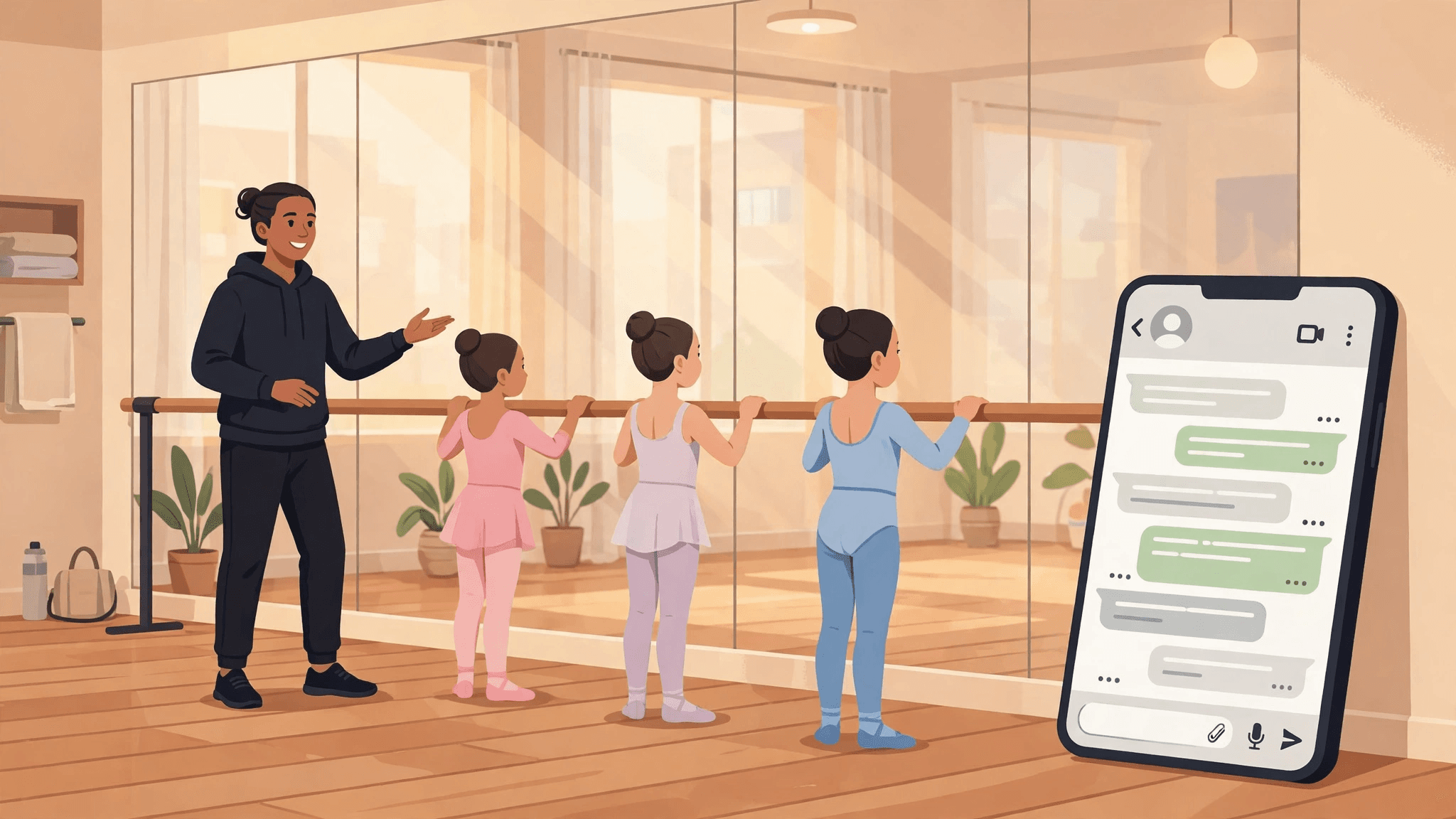
WhatsApp for dance studios starts with the message every studio knows: “what time is ballet for a seven-year-old on Saturday?” — sent at 8pm on a Thursday by a parent who has already looked at the website and still cannot tell which class fits their child. The answer depends on three things the parent needs before they will book: the child's age, the level, and the style — and a studio that answers that question in minutes gets the trial booking, while a studio that answers it the next morning gets a parent who has already booked somewhere else. A WhatsApp AI agent can run that conversation the moment it arrives: read the timetable, place the child in the right class, book the trial, and hand the teacher a register that is full before the term starts. This guide covers the studio side of it — the timetable, the trial class, the parent who messages on a child's behalf, term enrolment and the recital season, and the week an instructor falls ill — and the line the agent must not cross: it never promises a place in a class that is full, and it never answers a child directly.
That line matters here because a dance studio is not a gym with a timetable and a price list. A gym sells access; a studio sells a place in a specific class, at a specific level, with a specific teacher, on a specific day of the week — and that place is held for a whole term. The agent works from the studio's own documents — the timetable by age, level and style, the class caps, the term dates, the trial policy, the enrolment and cancellation rules — and when it does not know, it says so and hands the conversation to a person. A studio that sets that rule up front gets the speed of instant replies without ever placing a beginner in an advanced class or promising a full class a seat it does not have.
The timetable is the product
A dance studio's timetable is not a list of times — it is a grid, and every cell in it is a different class. Ballet for ages five to seven on Monday at 4pm is not the same class as ballet for ages eight to eleven on Monday at 5pm, and neither is the same as the adult beginners' tap on Thursday evening. The parent's question is never just “when is ballet?” — it is “when is ballet for my child?”, and the agent's job is to answer the question as asked, from the grid.
- Age, level and style come before the time. The agent asks the child's age and whether they have danced before, then offers only the classes that fit: a seven-year-old beginner gets the Monday 4pm pre-primary ballet, not the Saturday intermediate class that happens to have a free place.
- The class cap is part of the answer. A studio class holds a fixed number of dancers — the room, the teacher and the safety of the floor decide it — and the agent only offers places that exist. A full class gets a waitlist offer, not a booking, and the parent is told plainly which one it is.
- The term is the unit, not the week. Classes run in terms with start dates, half-term breaks and end dates, and the agent answers from the term calendar: a parent asking in week three is told the next start date, not sold a class that is already a third of the way through.
- The timetable changes, and the agent knows it. A class that moves from Tuesday to Wednesday, a new style added on Friday, a holiday closure — the agent answers from the current timetable, so a parent who asks in October is not given September's schedule.
The booking pattern behind offering the right class at the right level is covered in depth in the
Trial classes: the first class is a placement, not a booking
A trial class is how a studio fills its timetable — but it is also a placement decision, and the two are easy to confuse. A parent who books a trial wants their child to try the class; the studio wants the child in the class where they will stay. An agent that books the trial into the wrong level loses the enrolment either way: the child is bored in the beginners' class, or lost in the intermediate one, and the parent does not come back for the term.
- The trial is booked into a level, not a slot. The agent asks the age, the experience and the style the child wants, then books the trial into the class the teacher would choose — and says why, so the parent understands the placement instead of just receiving a time.
- The practical questions are answered before the class. What to wear, what shoes, whether a parent stays to watch, where to park, what door to use — the agent answers them from the studio's own first-class sheet, so the first visit starts calm instead of confused.
- The trial has a next step built in. After the class, the agent follows up with the parent — one message, not a campaign — asking how it went and offering the term place in that class while it is still open. A trial with no next step is a free class that never becomes an enrolment.
- A trial that does not fit gets moved, not lost. If the teacher says the child belongs a level up, or the parent realises the time does not work, the agent offers the right class or the right day in the same conversation — the trial moves with the child instead of ending in a shrug.
The gyms post covers the closest parallel — trial bookings that fill quiet classes — and the two link rather than duplicate: the
WhatsApp post for gyms handles adult trials and membership renewals; this one handles a child's first class, where the trial is a placement decision and the customer is the parent.
Parents message, children dance
Most of a dance studio's customers are parents, and the person who messages is rarely the person who dances. That changes the conversation: the agent is talking to the adult who pays, decides and collects — and it must never slip into talking to the child. The boundary is simple to state and worth writing down before the agent answers a single message.
- The parent is the customer. Enrolment, fees, consent forms and pickup arrangements are the parent's conversation, and the agent keeps them there — it answers the parent's questions and books the parent's child, and it never asks a child for information or a decision.
- Consent and pickup are part of the booking. The agent collects the enrolment form, the emergency contact and the pickup arrangement from the parent in the same thread as the booking, so the first class does not start with a teacher asking who is collecting a seven-year-old.
- The “is my child alright?” question has a human answer. A parent messaging mid-class about a child who is upset, hurt or anxious gets a person, not a bot — the agent hands the conversation to the studio immediately, because some questions are not for an automated reply.
- One parent, one thread. When two parents message about the same child, the agent keeps the enrolment, the payments and the pickup arrangement in the thread that booked the place, and tells the other parent where the booking lives — so the studio never has two half-enrolments for one child.
Term enrolment and the recital season
A studio's year has two rhythms: the term, which repeats, and the recital, which does not. The term is enrolment — a place held for ten or twelve weeks, paid per term, with the same class and the same teacher. The recital is the season when everything changes: extra rehearsals, costume fittings, show day, and a hundred parent questions that all arrive in the same week. The agent's job in both is the same — answer from the studio's own dates and rules, one parent at a time.
- Enrolment is a place held, not a ticket sold. The agent confirms the class, the level, the teacher, the term dates and the fee from the studio's own list, and records the enrolment against the parent — so the register the teacher works from matches the bookings the agent took.
- Re-enrolment is offered before the term ends. A parent whose child is in the Tuesday ballet class is offered the same class for the next term before it opens to new families — one message, while the place is still theirs, instead of a scramble when the timetable goes public.
- Recital questions are answered one-to-one. Rehearsal times, costume sizes, show-day call times, ticket arrangements — the agent answers each parent's question from the recital sheet the studio wrote, in that parent's own thread. Neksio answers customers one-to-one; it is not a bulk or broadcast tool.
- The recital never changes the class. A parent who asks about the show is told the rehearsal schedule and the show date — and the agent never moves a child to a different class, level or teacher because the recital season made the timetable look full.
When the teacher changes: cover classes and cancellations
The week an instructor falls ill is the week a studio's phone earns its keep — and it is the week the agent earns its place. Parents need one answer above all: is my child's class on today, and if it is, who is teaching it? The agent answers from the cover plan the studio wrote, not from a guess, and it says plainly when it does not know yet.
- “Is class on today?” gets a straight answer. The agent checks the day's timetable and the cover plan — class on with the usual teacher, class on with a cover teacher, or class cancelled — and answers in one message, so a parent is not left wondering at the studio door.
- A cover teacher is named, not hidden. When a cover teacher takes the class, the agent says who it is and that the class, time and level are unchanged — parents trust a named cover far more than a vague “another teacher”.
- A cancelled class becomes a credit or a catch-up, in the parent's thread. The agent states the studio's own rule — a credit, a catch-up class, or a refund where the studio offers one — at the moment of the cancellation, so the conversation about it is a reminder, not a negotiation.
- The agent never invents a cover. If no cover teacher is arranged yet, it says so honestly and hands the conversation to the studio — a class promised with a teacher who does not exist is worse than a class honestly marked uncertain.
The reminder playbook behind holding confirmed places is covered in the
reduce appointment no-shows guide.
An illustrative week with the agent
Take an illustrative example: a studio opens a new term with a timetable of twenty classes — ballet, tap, hip-hop and contemporary, from age four to adult — and the phone would normally ring all week with the same questions: “what time is ballet for a seven-year-old?”, “can my daughter try a class?”, “is class on this Saturday?”, “when is the recital?” Before the agent, the teacher answered those messages between classes or not at all, and every unanswered message was a trial that never happened.
With the agent, the week runs differently. A parent messages on Tuesday evening and books a trial for their seven-year-old into the right ballet level, with the what-to-wear answers in the same thread. On Thursday, a parent asks whether Saturday's tap class is on and gets a straight answer with the cover teacher named. On Friday, a parent whose child finished the trial is offered the term place while it is still open — and takes it. And when the recital rehearsal schedule goes out, each parent who asks gets their child's own rehearsal times in their own thread, answered from the recital sheet. The numbers in this example are illustrative; run your own enquiry volume through the free tier before deciding anything.
What WhatsApp for dance studios costs on Neksio
On Neksio, the plans follow the same shape as for any small business, and the unit is replies answered, not seats filled: Free covers 100 AI replies a month on WhatsApp, Starter at $12.99 a month covers 5,000 replies, Growth at $16.99 a month covers 15,000 replies and adds Facebook and Instagram, and Scale at $29.99 a month is unlimited replies with your own key, plus done-for-you onboarding. A studio does not pay for a team; it pays for the messages its agent answers — the timetable questions, the trial bookings, the parents asking about pickup and the recital. Start on Free — 100 replies a month covers the timetable and trial flow while you check whether the agent's answers and its boundaries are right — and move to Starter when the volume grows past that. Full detail is on the
pricing page. For the full setup — connecting WhatsApp, uploading your timetable, term dates and recital sheet, and letting the agent answer from them — the WhatsApp AI agent guide walks through it step by step.
Setting it up for a dance studio, in order
The order matters more than the tools. First, write the boundary: what the agent never does, and the exact handoff triggers — a class it cannot see a place in, a child it cannot place, a parent asking about a child mid-class, anything it cannot answer from your documents. Second, write the documents it answers from: the timetable by age, level and style, the class caps, the term dates, the trial policy, the enrolment and cancellation rules, the recital sheet. Third, build the trial flow around the placement — ask the age and experience first, then the style, then the time — and the parent flow that collects consent and pickup in the same thread. Fourth, set the term: re-enrolment offers before the term ends, and the cover plan for the week a teacher is ill. Fifth, run it on real messages for two weeks and read a sample of the conversations — especially the handoffs — before changing anything. The studios that struggle with a WhatsApp agent are rarely the ones with the wrong tool; they are the ones that connected it without writing the boundary first.
100 AI replies a month on WhatsApp, no credit card. Connect WhatsApp, upload your timetable, term dates and recital sheet, and let the agent answer the enrolment questions from your own words. Neksio answers customers one-to-one — it is not a bulk or broadcast tool. Full detail on the pricing page.
Frequently asked questions
- Can parents book a trial class on WhatsApp?
- Yes — a parent messages the studio with the child's age and experience, and the agent books the trial into the class the teacher would choose, then answers the practical questions (what to wear, what shoes, whether a parent stays to watch) from the studio's own first-class sheet.
- How does the agent place a child in the right level?
- From the studio's own timetable. The agent asks the child's age and whether they have danced before, then offers only the classes that fit that age and level — a seven-year-old beginner gets the pre-primary class, not the intermediate class that happens to have a free place.
- Does the agent talk to children directly?
- No. The parent is the customer — enrolment, fees, consent forms and pickup arrangements are the parent's conversation, and the agent keeps them there. A parent asking about a child mid-class is handed to a person at the studio immediately.
- What happens when a class is full?
- The agent offers the waitlist, not a booking, and says so plainly. A full class gets a waitlist place with the parent told which class and level it is for — and when a place opens, the agent offers it to the next parent on the list in their own thread.
- Can it handle term enrolment and the recital?
- Yes — the agent confirms the class, level, teacher, term dates and fee from the studio's own list, offers re-enrolment before the term ends, and answers each parent's recital questions (rehearsal times, costume sizes, show-day call times) one-to-one from the recital sheet.
- How much does WhatsApp for dance studios cost on Neksio?
- Neksio's Free plan covers 100 AI replies a month on WhatsApp with no card — enough for a small studio to run real timetable questions and trial bookings. Starter is $12.99/month for 5,000 replies, Growth is $16.99/month for 15,000 replies including Facebook and Instagram, and Scale is $29.99/month for unlimited replies with your own key plus done-for-you onboarding. Meta's WhatsApp conversation fees are billed separately by Meta.