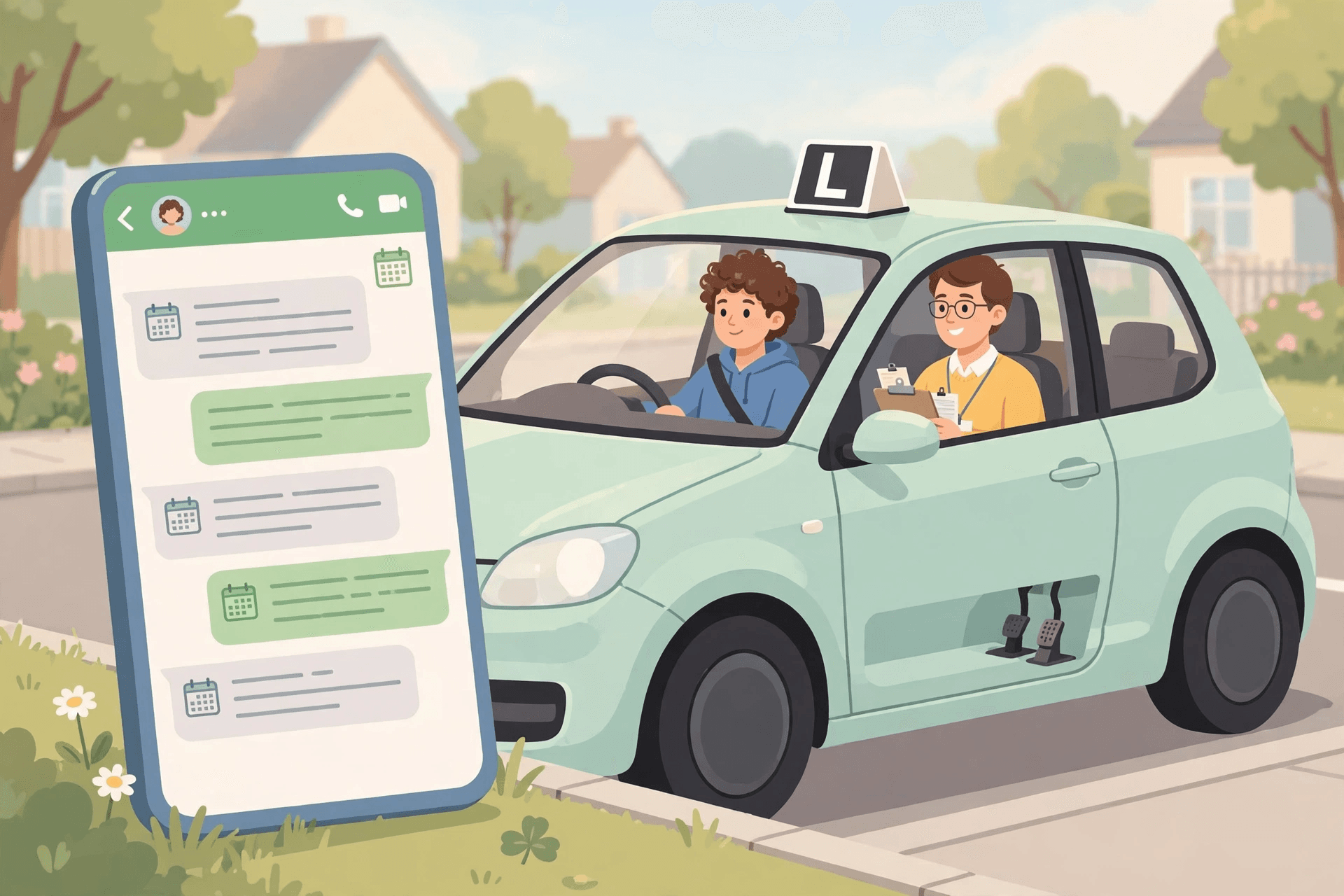
WhatsApp for driving schools starts with the message every school knows: “how much is a lesson, and can I book Tuesday at 4pm?” — sent at 9pm on a Sunday by someone who has decided, tonight, that they are going to learn to drive. The answer depends on four things the learner needs before they will book: which instructor has a free slot, whether the lesson is one hour or two, where the pickup is, and whether they have their provisional licence yet. A school that answers that question in minutes gets the booking; a school that answers it the next morning gets a learner who has already booked with the instructor down the road. A WhatsApp AI agent can run that conversation the moment it arrives: check the diary, offer the real slots, book the lesson, and hand the instructor a day that is full before the week starts. This guide covers the school side of it — the diary, the first lesson, the test countdown and the week something goes wrong — and the line the agent must not cross: it never books a lesson into a slot that does not exist, and it never promises a test date it cannot see.
That line matters here because a driving school is not a shop with opening hours and a price list. A school sells an instructor's time in a specific car, on a specific day, from a specific pickup point — and that instructor's diary is the whole business. The agent works from the school's own documents — the instructors and their cars, the diary, the lesson lengths and pickup rules, the block-booking terms, the test procedure — and when it does not know, it says so and hands the conversation to a person. A school that sets that rule up front gets the speed of instant replies without ever double-booking an instructor or sending a learner to a pickup point nobody is coming to.
The diary is the product
A driving school's diary is not a list of times — it is one diary per instructor, and every instructor has their own car, their own working days and their own patches. A Tuesday 4pm slot with one instructor is not the same as a Tuesday 4pm slot with another: one starts from the learner's home, the other finishes at the college, and the car that does the lesson is the car the learner will take the test in. The learner's question is never just “when can I have a lesson?” — it is “when can I have a lesson, with whom, from where?”, and the agent's job is to answer the question as asked, from the diary.
- Instructor, car and diary come together. The agent offers only slots that exist in a named instructor's diary, in the car that instructor drives — so a learner is never booked with an instructor who is off that day, or into a car that is booked for another learner.
- Lesson length is part of the booking. A one-hour lesson and a two-hour lesson are different bookings with different prices and different diary space, and the agent asks which one the learner wants before it offers a time — a two-hour lesson booked as a one-hour lesson leaves a learner short and an instructor late for the next pupil.
- Pickup and drop-off are in the booking, not after it. The agent records where the lesson starts and where it ends — home, work, college — so the instructor drives to the right address instead of ringing the learner from the wrong street.
- The provisional licence is checked before the first lesson. A learner without a valid provisional licence cannot legally drive, and the agent asks before booking: no licence, no lesson, and a clear note of what the learner needs to bring instead of a wasted diary slot.
The booking pattern behind offering the right slot in the right diary is covered in depth in the
The first lesson: a nervous learner, not a sale
Most learners message a driving school having never driven a car, and the first lesson is the one that decides whether they come back. The questions are not about price — they are about what will happen: what do I bring, where do we meet, will I be driving on a real road, what if I stall. An agent that answers those questions calmly, from the school's own first-lesson sheet, turns a nervous enquiry into a booked lesson; an agent that treats the first lesson like any other booking loses the learner before they have sat in the car.
- The practical questions are answered before the lesson. What to bring, where the instructor will meet them, how long the lesson lasts, whether a parent can come along — the agent answers them from the school's own first-lesson sheet, so the first lesson starts calm instead of confused.
- The lesson is matched to the learner, not the diary. A learner who has never driven gets a quiet-road first lesson with an instructor who teaches beginners; a learner who has driven before and needs a refresher gets a different first lesson entirely. The agent asks about experience before it offers a slot.
- A block booking is offered after the first lesson, not instead of it. Ten lessons bought up front is good business for the school and good value for the learner — but only once the learner has met the instructor and knows the lessons work. The agent offers the block after the first lesson, in the learner's own thread, and states the school's own terms for it.
- The learner is the customer, even when a parent pays. A teenager learning to drive often has a parent paying for the lessons, and the agent keeps the two conversations straight: the learner books the lessons and gets the reminders, the parent gets the payment and progress conversation — and the agent never hands the learner's diary to someone the learner has not named.
The closest parallel is the language school, where the first class is also a placement — and the two link rather than duplicate: the
WhatsApp post for language schools places a student in a batch by level and language; this one places a learner in a diary by instructor, car and pickup point, where the first lesson is a nerves question as much as a booking.
Test-date reminders: the countdown is the job
A driving school's real deadline is not the next lesson — it is the test. A learner has a theory test booked, then a practical test, and between the two sits a diary full of lessons that have to land in the right order: enough lessons before the theory test, the right practice before the practical, and the school's car available on test day. The reminders are what keep that chain from breaking, and they only work if they are personal: one learner, one test date, one thread.
- The theory test gets a countdown, not a single reminder. The agent reminds the learner as the date approaches — what to revise, what to bring, where the test centre is — in the learner's own thread, so the reminder is a conversation the learner can answer, not a message that arrives and is forgotten.
- The practical test is planned backwards from the date. The agent works from the school's own test-day rules: the lessons that should happen in the final week, the mock test if the school offers one, and the car that will be used on the day — so a learner is never a week from their test with no lesson booked and no car arranged.
- Test day has a checklist, not a guess. What documents to bring, what time the instructor collects them, which car, where the test centre is — the agent sends the school's own test-day checklist in the learner's thread, and answers the questions that follow it, one learner at a time.
- A failed test becomes a new plan, not a lost learner. When a learner does not pass, the agent offers the next steps from the school's own rules — the rebooking window, the lessons the instructor recommends before the next attempt — in the same thread, while the learner is still deciding whether to carry on. Neksio answers learners one-to-one; it is not a bulk or broadcast tool.
The disrupted day: illness, breakdowns and bad weather
The morning an instructor wakes up ill, or a car fails its check, is the morning a driving school's phone earns its keep — and it is the morning the agent earns its place. Learners need one answer above all: is my lesson on today, and if it is, who is teaching it and in which car? The agent answers from the plan the school wrote, not from a guess, and it says plainly when it does not know yet.
- The 7am call goes to the agent first. When an instructor rings in ill, the agent checks that instructor's diary and tells each affected learner in their own thread — lesson on with a named cover instructor, or lesson moved to the next free slot — before the learner sets out for the pickup point.
- A car that fails its check moves the lesson, it does not cancel the learner. The agent states the school's own rule at once: the lesson moves to the next free slot with that instructor, or to a cover instructor in another car — and the learner is told which one it is, in their own thread, instead of finding out at the kerb.
- Bad weather gets the school's rule, not the agent's opinion. Lessons in heavy rain or snow follow the school's own policy, and the agent states it: lessons on, lessons moved, or the instructor's call on the day. A learner is never left guessing whether to wait outside in the rain.
- A test-day disruption is the highest-stakes message of all. If the car meant for a practical test cannot go, or the instructor cannot attend, the agent tells the learner immediately, states what the school will do about the test — the rebooking path and the lessons before the next attempt — and hands the conversation to the school. And the agent never invents a cover: if no cover instructor is arranged yet, it says so honestly instead of promising a lesson with an instructor who does not exist.
The reminder playbook behind holding confirmed lessons is covered in the
reduce appointment no-shows guide.
Follow one learner from first message to test day
Take an illustrative example: one learner, from the first message to the practical test. On a Sunday evening they message asking how much a lesson is and whether Tuesday at 4pm is free. The agent checks the diary, asks about experience and lesson length, confirms the pickup point and the provisional licence, and books a two-hour first lesson for Tuesday — with the what-to-bring answers in the same thread.
The first lesson goes well, and the learner takes the block booking the agent offers afterwards. Over the next weeks the lessons land in the diary around work and college, each one booked in the same thread. Three weeks before the theory test, the countdown reminders start — what to revise, what to bring, where the test centre is. The learner passes, and the agent plans the final week backwards from the practical test date: the last lessons, the mock test the school offers, and the car that will be used on the day. On test day the checklist arrives in the learner's thread — documents, pickup time, car, test centre. And when one lesson in the middle of it all has to move because the car fails a check, the learner hears about it in their own thread, with the new slot already offered. The numbers in this example are illustrative; run your own enquiry volume through the free tier before deciding anything.
What it costs on Neksio: replies, not instructors
A driving school does not pay per instructor or per car on Neksio — it pays for the replies its agent answers. One learner's whole arc, from the first “how much is a lesson?” to the test-day checklist, is a handful of replies: the diary questions, the booking, the reminders, the moved lesson. That is the unit the plans are priced in. Free covers 100 AI replies a month on WhatsApp, which is enough to run the diary and the test reminders for a small school and see whether the agent's answers and boundaries are right. Starter at $12.99 a month covers 5,000 replies, Growth at $16.99 a month covers 15,000 replies and adds Facebook and Instagram, and Scale at $29.99 a month is unlimited replies with your own key, plus done-for-you onboarding. Move up when the diary fills and the replies grow past the tier you are on — not before. Full detail is on the
pricing page. For the full setup — connecting WhatsApp, uploading your instructors, diaries and test-day rules, and letting the agent answer from them — the WhatsApp AI agent guide walks through it step by step.
Start with the diary, not the agent
The schools that struggle with a WhatsApp agent are rarely the ones with the wrong tool; they are the ones that connected it without writing anything down first. Before the agent answers a single message, write four things in the school's own words. The diary rules: which instructor drives which car, which days each one works, the lesson lengths and the pickup rules, and the provisional-licence check. The test rules: the theory countdown, the practical planning, the test-day checklist and the car for test day. The disruption rules: the cover instructors, the cars, and what happens to a lesson that has to move. And the handoff list: the messages that always go to a person — a diary slot the agent cannot see, a learner without a licence, a test date it cannot confirm, a parent asking about a learner mid-lesson, anything it cannot answer from the documents. Then build the booking flow around the diary — experience first, then instructor and lesson length, then pickup — and the test flow that counts down from the test date instead of sending one reminder. Run it on real messages for two weeks and read a sample of the conversations, especially the handoffs, before changing anything.
100 AI replies a month on WhatsApp, no credit card. Connect WhatsApp, upload your instructors, diaries and test-day rules, and let the agent answer the booking questions from your own words. Neksio answers customers one-to-one — it is not a bulk or broadcast tool. Full detail on the pricing page.
Frequently asked questions
- Can learners book a driving lesson on WhatsApp?
- Yes — a learner messages the school with the day and time they want, and the agent checks the instructor's diary, asks about experience, lesson length and pickup point, then books the lesson into a real slot. The provisional licence is checked before the first lesson is confirmed.
- What does the agent need to book a lesson?
- Four things: the learner's experience, the lesson length (one or two hours), the pickup and drop-off points, and a valid provisional licence. With those, the agent offers only slots that exist in a named instructor's diary, in that instructor's car.
- Can it remind me about my driving test?
- Yes — the agent counts down to the theory and practical test dates in the learner's own thread, with the school's own reminders about what to revise, what to bring and where the test centre is, and the test-day checklist for the practical test.
- What happens if my instructor cancels or the car breaks down?
- The agent tells the learner in their own thread whether the lesson is on with a named cover instructor or moved to the next free slot, stating the school's own rule at the moment of the cancellation. If no cover is arranged yet, it says so honestly and hands the conversation to the school.
- Can a parent book lessons for their teenager?
- The learner books the lessons and gets the reminders, because the diary, the pickup point and the test date belong to the learner. A parent who is paying gets the payment conversation in their own thread — and the agent never hands the learner's diary to someone the learner has not named.
- How much does WhatsApp for driving schools cost on Neksio?
- Free covers 100 AI replies a month on WhatsApp with no card — enough to run real lesson bookings and test-date reminders for a small school. Starter is $12.99 a month for 5,000 replies, Growth $16.99 a month for 15,000 replies including Facebook and Instagram, and Scale $29.99 a month for unlimited replies with your own key plus done-for-you onboarding. Meta's WhatsApp conversation fees are billed separately by Meta.