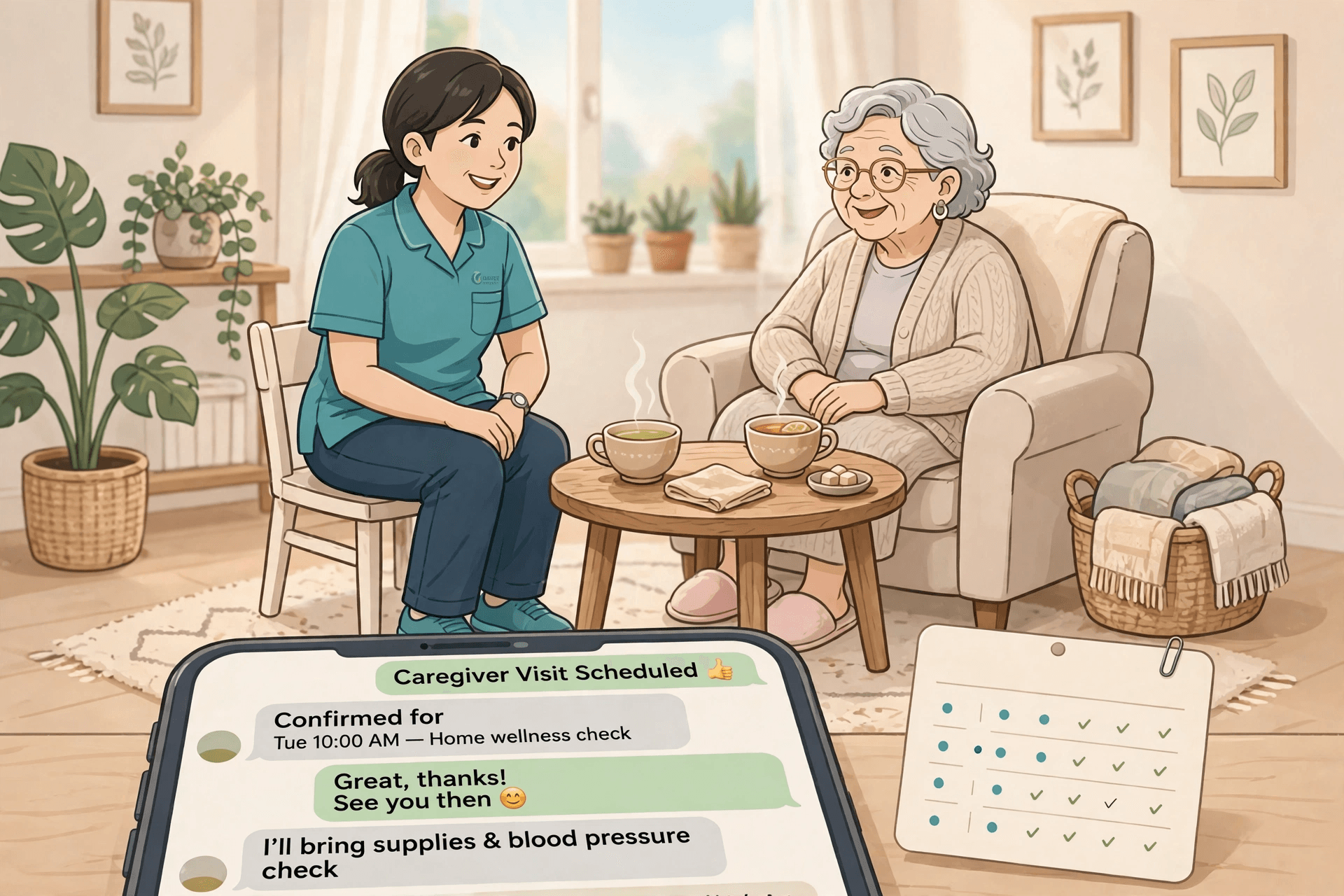
WhatsApp for home care agencies is not a receptionist for a clinic — it is the switchboard for an agency whose work happens in other people's living rooms. A home care agency runs on phone calls: a daughter ringing to ask how her mum's morning visit went, a caregiver texting that she is running twenty minutes late, a coordinator trying to fill a Friday shift while three families wait for a call back. The admin around those conversations — answering the same questions, offering shifts, confirming visits, passing updates to families — is exactly the work an AI agent can take over. The care itself is not. This guide covers the agency side: caregiver scheduling, family updates, new-client enquiries, and the boundaries that keep the agent firmly on the admin side of the line.
The boundary is worth stating before anything else, because it shapes every decision that follows: the agent handles scheduling, visit confirmations, family updates, service questions, and assessment bookings. It never gives clinical advice or diagnoses, never changes a care plan, and never answers a question about medication or a client's health — anything care-related goes to a coordinator or a nurse, with the full conversation attached. An agency that sets that rule up front gets the automation without ever putting a family in the position of taking care advice from a bot.
Three inboxes in one: families, caregivers, coordinators
A clinic's inbox is mostly patients. A home care agency's inbox is three different audiences writing about the same visit, and each of them needs a different answer. The agent's job is to tell them apart and answer each one from the right documents.
- Families. Adult children and spouses, usually writing in the evening or after a visit: “How did Mum's visit go today?” “Is someone coming on Saturday?” “Can we add an extra visit next week?” They want reassurance and a straight answer, and they will ring the office if the chat goes quiet.
- Caregivers. The people doing the visits: “Can I swap my Thursday shift?” “I'm stuck in traffic — I'll be twenty minutes late.” “Is Mrs. Patel's visit still 9am?” They need short, certain answers — a confirmed shift, a swapped slot, a message passed to the family — not a phone queue.
- Coordinators. Your own team, and the people the agent hands work to: a shift nobody has accepted, a family asking for a change to the care plan, a new enquiry that needs an assessment. The agent's job is to surface these fast, with the whole conversation attached, so a coordinator picks up a ready-made thread instead of a cold call.
That split is what makes home care different from a clinic or a therapy practice. The agent is not answering one kind of question for one kind of person — it is keeping three groups in step around a schedule that changes every day, and the handoff has to land with the right person each time.
Caregiver scheduling on WhatsApp
Scheduling is where a home care agency loses most of its day. Shifts change constantly — a client adds a visit, a caregiver calls in sick, a family asks to move a regular Tuesday to Thursday — and every change is a round of phone calls. On WhatsApp, the same work becomes a short exchange the agent can run on its own.
The pattern that works is the shift offer. When a slot opens, the agent messages the caregivers who can take it — the ones who cover that area, who are free at that time, who already know the client — with the visit details and a one-tap accept or decline. The first to accept gets the shift, the others get a short thanks, and the coordinator sees the filled rota instead of a list of unanswered calls. If nobody accepts, the agent escalates to the coordinator with the names of who was asked, so the follow-up starts from facts instead of guesswork.
- Shift swaps. A caregiver who cannot make Thursday offers the shift in the chat; the agent offers it to the caregivers who cover that client, confirms the swap, and tells the family who is coming instead.
- Late and no-show cover. A caregiver running late messages the agent, which passes the new arrival time to the family and flags the coordinator if the visit cannot happen at all — so cover is arranged before the family starts ringing.
- Availability updates. Caregivers tell the agent which days they can work next week, and the agent answers from that, not from a rota printed on Monday that was out of date by Tuesday.
- Regular rounds. Most clients have the same visits every week with the same caregiver. The agent confirms the week's round, flags the changes, and only bothers the coordinator with the exceptions.
One rule keeps scheduling honest: the agent offers real, open shifts from the agency's rota, and never promises a caregiver a shift that is already filled, or a family a visit nobody has accepted. A filled shift that was never confirmed is worse than an empty one — the family expects someone who is not coming. The booking side of the agent is covered in depth in the
Family updates that stop the “how is Mum doing?” calls
The call every home care coordinator knows is the one that starts “I just wanted to check how Mum is doing.” It is a reasonable question, and it is also the twentieth time someone has asked it this week. Families do not ring because they doubt the care — they ring because nobody told them the visit happened. A short update after each visit ends most of those calls before they are made.
The update itself is simple and deliberately narrow: the visit happened, at what time, and the practical facts the family needs — that the visit went ahead as planned, that the next visit is on its usual day, and who to contact if anything changes. It is sent as an approved template message to the family contact the agency has on file, and only to them. Care notes stay in the agency's own records; the WhatsApp update is a confirmation, not a medical record, and it never contains clinical detail, health observations, or anything about medication.
Families can also ask the agent for the things they ask the office for: the week's visit times, who the regular caregiver is, how to add an extra visit, how to change a regular day. All of it is answered from the agency's own documents — the visit schedule, the service list, the change policy — and anything that touches the care plan itself goes to a coordinator. The reminder playbook behind visit confirmations — including the no-show math — is covered in the
reduce appointment no-shows guide.
New-client enquiries: from first message to first visit
A new enquiry to a home care agency is usually written by a family member who has just realised a parent needs help — often late at night, often after a hospital discharge, and almost always with the same first questions: what services do you offer, do you cover our area, what does it cost, and how quickly can someone start? The agent answers those from the agency's documents while the family is still deciding, instead of letting the enquiry wait until the office opens.
The conversation that follows has a shape of its own. First, the practical questions: services, areas covered, visit lengths, and rates — all fixed answers that belong in the agent's documents. Then the qualification: where the client lives, what kind of help is needed, how often, and whether a family member can be present for the first visit. Then the step that matters most: booking a care assessment, where a coordinator or nurse visits the client and agrees the care plan in person. The agent books the assessment and confirms it with the time, who is coming, and what the family should have ready. It never assesses needs itself, and it never agrees a care plan — that happens at the visit, with a human.
The clinics post covers the same shape of problem from the other side — a general medical clinic's appointment flow — and the two link rather than duplicate: the
WhatsApp post for clinics handles doctor availability and walk-in timing; this one handles a care service that starts with an assessment in the client's own home.
The care boundary: what the agent must never do
This is the section to set up first and check most often. A home care agency's agent needs explicit instructions about what it does not do, written in plain language, because the cost of getting it wrong is not a lost booking — it is a family acting on guidance from a bot about someone they love.
- No clinical advice or diagnoses. The agent does not discuss symptoms, suggest what a client's condition means, or comment on whether care is needed. Any message in that direction is handed to a coordinator or nurse with the full thread attached.
- No care-plan changes. Adding visits, changing visit times, or altering what a caregiver does at a visit is a coordinator's decision. The agent can take the request and pass it on; it cannot agree to it.
- No medication answers. Questions about medication — doses, timing, missed doses, side effects — go straight to a nurse or coordinator. The agent never answers them, even from its documents.
- No emergencies handled in chat. If a family or caregiver reports an urgent problem, the agent points them to emergency services and flags the conversation to the coordinator immediately. Set this trigger before the agent ever talks to a real family, and test it.
- A handoff list, written down. Care questions, medication, complaints, fee disputes, safeguarding concerns, and any message the agent cannot answer from the agency's documents all go to a human. The handoff carries the whole conversation, so the coordinator reads the context instead of asking the family to repeat it. The handoff pattern is explained in the
Review the boundary monthly. Read a sample of real conversations — especially the ones that were handed off — and check two things: did the agent stay on the admin side of the line, and did the handoff happen fast enough? The most common failure is not the agent saying something clinical; it is the agent trying to be helpful about a question it should have passed on. Tighten the handoff triggers whenever you find one.
Keeping client details private in the chat
Home care runs on personal information — names, addresses, visit times, family contacts — and the inbox has to show that the agency treats it that way. Three practical rules cover most of it. First, keep care notes and health information out of WhatsApp entirely: they live in the agency's own records, and the agent never sees them. Second, keep the agent's knowledge to admin: services, areas, rates, visit schedules, and the change policy. Third, limit who sees the inbox: conversations route to the coordinator who owns that client, not to everyone on the team, and the handoff carries context only to the person who needs it.
The agent should also be honest in its first message about what it is: the agency's scheduling and updates assistant, not a carer, and not a person. Families who know they are talking to an assistant ask it scheduling questions; families who think they are talking to their mum's caregiver tell it things meant for the care team. That one sentence at the start of the conversation prevents most of the boundary problems that follow.
An illustrative week with the agent
Take an illustrative example: a small agency with about forty clients, each with two or three visits a week, and a dozen caregivers. Before the agent, the coordinator spent the morning on the phone — confirming the day's visits, chasing a caregiver who had not replied about a Friday shift, and taking calls from families asking whether the morning visit had happened. Every change meant another round of calls, and a sick caregiver on a Monday morning could take the whole day to cover.
With the agent, the week's round is confirmed in the chat the evening before, the Friday shift goes out as offers to the caregivers who cover that area and is accepted by the first to reply, and each family gets a short message after each visit saying it happened. The caregiver who is stuck in traffic tells the agent, which passes the new arrival time to the family before they ring. The coordinator's morning starts with the rota filled and the exceptions flagged — and with one conversation handed over: a family asking to add a visit, routed to the coordinator the moment it arrived. The numbers in this example are illustrative; run your own visit volume through the free tier before deciding anything.
What WhatsApp for home care agencies costs on Neksio
On Neksio, the plans follow the same shape as for any small agency, and the unit is replies answered, not seats filled: Free covers 100 AI replies a month on WhatsApp, Starter at $12.99 a month covers 5,000 replies, Growth at $16.99 a month covers 15,000 replies and adds Facebook and Instagram, and Scale at $29.99 a month is unlimited replies with your own key, plus done-for-you onboarding. A home care agency does not pay for a team; it pays for the messages its agent answers — the shift offers, the visit confirmations, the family updates. Start on Free — 100 replies a month covers the evening new-client questions while you check whether the agent's answers and its boundaries are right — and move to Starter when the volume grows past that. Full detail is on the
pricing page. For the full setup — connecting WhatsApp, uploading your services, areas and visit schedules, and letting the agent answer from them — the WhatsApp AI agent guide walks through it step by step.
Setting it up for a home care agency, in order
The order matters more than the tools. First, write the boundary: what the agent never does, and the exact handoff triggers — care questions, medication, emergencies, complaints, anything it cannot answer from your documents. Second, write the documents it answers from: services, areas covered, rates, visit schedules, and the change policy — admin only, nothing clinical. Third, build the scheduling flow around real shifts and the family-update message that goes out after each visit, and the assessment booking that follows a new enquiry. Fourth, set the visit confirmations: the evening-before confirmation and the after-visit update, both carrying who is coming and how to reach the coordinator. Fifth, run it on real messages for two weeks and read a sample of the conversations — especially the handoffs — before changing anything. The agencies that struggle with a WhatsApp agent are rarely the ones with the wrong tool; they are the ones that connected it without writing the boundary first.
100 AI replies a month on WhatsApp, no credit card. Connect WhatsApp, upload your services, areas and visit schedules, and let the agent answer the scheduling questions from your own words. Neksio answers families and caregivers one-to-one — it is not a bulk or broadcast tool. Full detail on the pricing page.
Frequently asked questions
- How do caregivers accept or swap shifts on WhatsApp?
- When a shift opens, the agent messages the caregivers who cover that area and time with the visit details and a one-tap accept or decline. The first to accept gets the shift, and the others get a short thanks. To swap, a caregiver offers the shift in the chat; the agent offers it to the caregivers who cover that client, confirms the swap, and tells the family who is coming instead.
- What do families actually receive after a visit?
- A short message confirming the visit happened, at what time, and when the next visit is — sent to the family contact the agency has on file. It is a confirmation, not a medical record: it never contains clinical detail, health observations, or anything about medication. Care notes stay in the agency's own records.
- Can the agent answer questions about care plans or medication?
- No. Questions about care plans or medication are handed to a coordinator or nurse with the full conversation attached. The agent handles scheduling, visit confirmations, family updates, service questions and assessment bookings — it never gives clinical advice or diagnoses, and it never changes a care plan.
- How do you keep client details private in WhatsApp chats?
- Care notes and health information stay in the agency's own records and never go into the agent's documents. The agent answers only from admin documents — services, areas, rates, visit schedules and the change policy — and conversations route to the coordinator who owns that client, not to the whole team.
- Can families book a care assessment over WhatsApp?
- Yes. After the agent answers the service, area and rate questions, it takes the details — where the client lives, what kind of help is needed, how often — and books the assessment visit, confirming the time, who is coming, and what the family should have ready. The assessment itself, and the care plan, happen at the visit with a human.
- How much does WhatsApp for home care agencies cost?
- Neksio's Free plan covers 100 AI replies a month on WhatsApp with no card — enough for a small agency to trial real scheduling and family updates. Starter is $12.99/month for 5,000 replies, Growth is $16.99/month for 15,000 replies including Facebook and Instagram, and Scale is $29.99/month for unlimited replies with your own key plus done-for-you onboarding. Meta's WhatsApp conversation fees are billed separately by Meta.