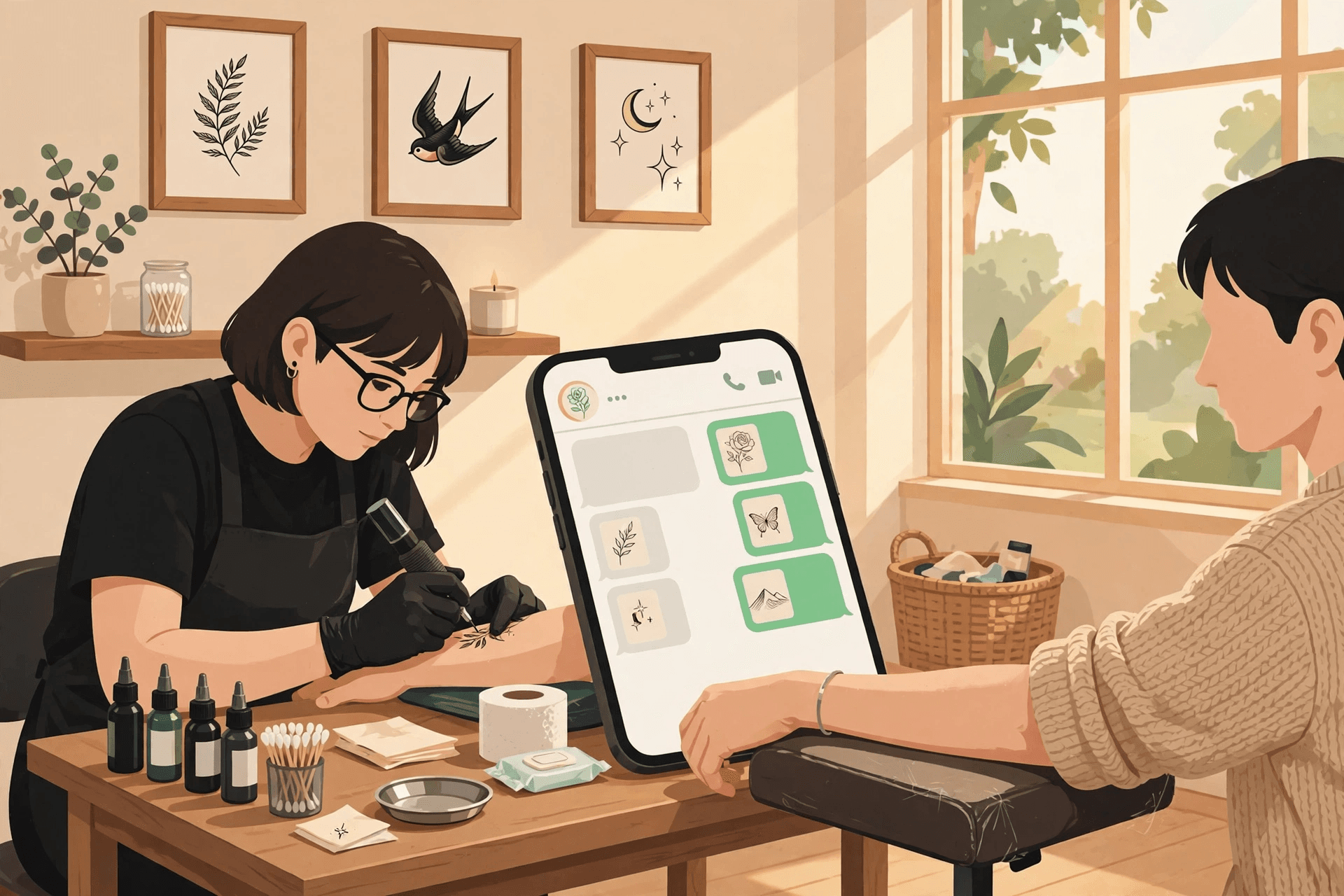
WhatsApp for tattoo studios starts with the message every studio knows: a photo of a tattoo someone else has, sent at 10pm, with the words “can you do this?” attached. It arrives while the artist is mid-session, gloves on, from someone who has already messaged two other studios and will book with the one that answers first. The sale depends on four answers the client needs before they will commit: does the studio do this style, which artist should do it, what will it cost, and when can it happen. A WhatsApp AI agent can run that conversation the moment it arrives: take the reference photos, ask the placement and size, collect the deposit, and book the sessions — and hand the artist a consult that is ready to draw. This guide covers the tattoo side of it — the design consult, the deposit that holds the date, the multi-session booking, and the aftercare questions that follow — and the line the agent must not cross: it never designs a tattoo, never quotes a price the studio has not set, and never diagnoses a healing tattoo.
That line matters more here than in most businesses, because a tattoo is permanent and the consult is where the studio earns the trust to make it. The agent works from the studio's own documents — the artists and their styles, the price list and minimums, the deposit policy, the session diary — and when it does not know, it says so and hands the conversation to a person. A studio that sets that rule up front gets the speed of instant replies without ever promising a design it cannot draw or a price it cannot honour.
The consult: reference photos, style, placement, size
A tattoo consult is not a booking form — it is a design conversation, and the agent's job is to collect the material the artist needs to have it. The client usually arrives with a screenshot, not a specification, and the questions that turn that screenshot into a bookable consult are always the same ones.
- The reference photos. The agent takes the images the client sends — screenshots, photos of someone else's tattoo, a sketch of their own — and stores them with the enquiry, exactly as sent. It never promises the studio will copy another artist's work; it asks what the client likes about it, so the artist can draw something original in that direction.
- The style and the artist. Fine line, blackwork, traditional, realism, lettering — the agent asks which style the client wants and matches it to the artists who actually work in it, from the studio's own artist list. A client who wants realism does not get booked with the lettering specialist.
- The placement and the size. Where on the body, and how big — a forearm piece, a full sleeve, a small ankle design. Placement decides the session length and the price range, so the agent asks it before anything is quoted.
- The timing and the budget. When the client wants it done, and what they are prepared to spend — the agent takes both as the client's own words, and never turns a budget into a price the studio has not set.
The conversation ends with the consult written down in one message the client can check: the reference photos, the style, the placement and size, the artist, and the date of the consult. The artist reads one thread instead of scrolling through a week of scattered messages to find the photo. That is the whole point — the agent's value is not the chat, it is the consult that arrives complete enough to draw from. The booking pattern behind this handoff is covered in depth in the
Deposits: the deposit holds the date
A tattoo session is not a haircut — it is hours of an artist's day, a design drawn in advance, and a slot that cannot be filled at short notice. That is why studios take deposits, and why the deposit conversation is where most WhatsApp enquiries die: the client asks the price, the studio replies, and then nothing happens for three days while the client decides. The agent's job is to make the deposit easy to pay the moment the client says yes.
- The deposit is stated from the studio's policy. A fixed amount or a share of the quoted price, non-refundable or transferable — the agent states the studio's own terms, word for word, and never invents a number or softens a policy the studio wrote.
- The payment link arrives in the same conversation. The moment the client agrees, the agent sends the studio's payment link — the client pays without leaving WhatsApp, and the date is held the moment the payment lands.
- The reschedule rule is stated before payment, not after. “Your deposit holds the 14th; if you need to move it, tell us at least 48 hours ahead and the deposit moves with you.” The client agrees to the rule while they are still deciding, not after they have paid.
- An unpaid enquiry is not a booking. Until the deposit lands, the date stays open — and the agent says so plainly, so a client who never pays never blocks a date another client would have taken.
One rule keeps deposits honest: the agent only confirms a date the diary actually shows and a deposit the studio actually received. A date promised in chat and double-booked in reality is worse than a date honestly offered for next week — the first loses a client and an artist's day, the second keeps both. The reminder playbook behind holding confirmed dates is covered in the
reduce appointment no-shows guide.
Multi-session booking: one tattoo, several sittings
Most tattoos that matter take more than one session — a sleeve, a back piece, a large colour design — and the booking is not one appointment but a sequence, with healing time between each sitting. A generic booking bot books one slot; a tattoo agent books the sequence and keeps it together.
- The sessions are planned together. The first session, the second, and the third are offered as a set from the artist's diary — “session one on the 14th, session two on the 5th, session three on the 26th” — so the client commits to the whole piece, not just the first sitting.
- Healing gaps are part of the booking, not an afterthought. The agent spaces the sessions by the healing time the studio has set, and never offers a second session inside it — a client booked too soon is a client whose tattoo heals badly.
- The same artist, every session. A multi-session piece belongs to one artist, and the agent books every sitting with that artist — it never fills a gap in the sequence with whoever happens to be free.
- The touch-up is booked, not promised vaguely. A free touch-up inside the studio's window is offered as a real appointment at the end of the sequence — “your touch-up is booked for the 16th, six weeks after the last session” — instead of a line the client has to remember to ask about.
When a session has to move, the agent moves the sequence, not just the one date — it offers the next sitting that still leaves the healing gap intact, and tells the client what changed and why. A moved session that breaks the healing gap is a booking the studio will regret, and the agent is the one place that rule can be enforced automatically.
Aftercare: the questions that arrive at midnight
The messages do not stop when the tattoo is finished — they change. “Is this normal?”, “Can I shower?”, “When can I go swimming?”, “It looks dry, what do I put on it?” A fresh tattoo heals for weeks, and the client asks the questions when they notice something, which is usually late at night. The agent answers from the studio's own aftercare sheet, and that sheet is the whole product here.
- The aftercare sheet is the agent's only source. Washing, moisturising, what to avoid and for how long — the agent quotes the studio's written instructions, and when the sheet does not cover the question, it hands the conversation to a person instead of guessing.
- What is normal, what is not. The agent can describe what the studio's sheet says is normal healing, and it can say plainly when something needs a human — redness spreading, swelling, heat, or anything the client is worried about goes to the artist the same day, not to a chatbot's opinion.
- The agent never diagnoses. It never tells a client a tattoo is infected or that it is fine — it gives the studio's instructions, and it escalates anything that sounds like a problem to a person with the full conversation attached.
- The touch-up reminder is timed to healing. Six weeks after the last session, the agent checks in — “how is it healing? Your touch-up is booked for the 16th” — and that message is also the moment a client who has been quietly worrying finally asks.
Write the aftercare script with the artist, not for them — read it out loud, and if any line sounds like medical advice, rewrite it as the studio's instruction or a handoff. The handoff pattern behind offering a person at the right moment is explained in the
No-shows and cancellations: a session is a day's income
A no-show in a tattoo studio is not a missed appointment — it is an artist sitting idle for four hours with a design already drawn and nobody in the chair. The deposit is the first defence, and the agent is the second: a confirmation the day before, a reminder the morning of, and a waitlist that fills the gap when someone cancels.
- A day-before confirmation with the deposit behind it. “Still good for tomorrow at 11am? Reply YES to confirm.” A client who has paid a deposit and confirmed twice shows up — and one who does not reply gets a follow-up while there is still time to fill the chair.
- A cancellation becomes a waitlist offer, not an empty chair. When a client cancels, the agent messages the waitlist in order — “a four-hour slot opened tomorrow at 11am, first to confirm gets it” — and the first client who confirms and pays the deposit takes it.
- The cancellation policy is stated at booking, not at the argument. The agent states the notice period and what happens to the deposit when the client books, so the conversation about a cancelled session is a reminder, not a negotiation.
The salon post covers the closest parallel — a chair that earns nothing when it sits empty — and the two link rather than duplicate: the
WhatsApp post for salons handles repeat appointments measured in minutes; this one handles a commission measured in sessions, deposits, and healing time.
An illustrative afternoon with the agent
Take an illustrative example: a studio opens on a Friday with two artists tattooing and a third on a consultation day. Before the agent, the phone buzzed all afternoon — a photo of a sleeve with “how much?”, a flash design with “can I come in today?”, a healed tattoo with “is this normal?” — and every message pulled an artist away from the chair or waited until the evening to be answered.
With the agent, the afternoon runs differently. A client sends a reference photo for a forearm piece; the agent asks the size and placement, matches the style to the right artist, and books a consult for Saturday. Another wants a small flash design and asks if there is anything this week; the agent offers the open slot on Thursday, states the deposit, and sends the payment link — the date is held before the client puts the phone down. A third is three days into healing and worried about dryness; the agent gives the studio's aftercare instructions and offers the artist directly — and the artist replies within the hour. The numbers in this example are illustrative; run your own enquiry volume through the free tier before deciding anything.
What WhatsApp for tattoo studios costs on Neksio
On Neksio, the plans follow the same shape as for any small business, and the unit is replies answered, not seats filled: Free covers 100 AI replies a month on WhatsApp, Starter at $12.99 a month covers 5,000 replies, Growth at $16.99 a month covers 15,000 replies and adds Facebook and Instagram, and Scale at $29.99 a month is unlimited replies with your own key, plus done-for-you onboarding. A studio does not pay for a team; it pays for the messages its agent answers — the consults, the deposit questions, the aftercare messages at midnight. Start on Free — 100 replies a month covers the consult flow while you check whether the agent's answers and its boundaries are right — and move to Starter when the volume grows past that. Full detail is on the
pricing page. For the full setup — connecting WhatsApp, uploading your artist list, price list, deposit policy and aftercare sheet, and letting the agent answer from them — the WhatsApp AI agent guide walks through it step by step.
Setting it up for a tattoo studio, in order
The order matters more than the tools. First, write the boundary: what the agent never does, and the exact handoff triggers — a design it cannot judge, a price it has not been given, a healing question that sounds like a problem, anything it cannot answer from your documents. Second, write the documents it answers from: the artist list with styles, the price list and minimums, the deposit and reschedule policy, the aftercare sheet. Third, build the consult flow around the four questions — reference photos, style and artist, placement and size, timing and budget — and the deposit step that holds the date. Fourth, set the session sequence: the healing gaps, the same-artist rule, and the touch-up booked at the end. Fifth, run it on real messages for two weeks and read a sample of the conversations — especially the handoffs — before changing anything. The studios that struggle with a WhatsApp agent are rarely the ones with the wrong tool; they are the ones that connected it without writing the boundary first.
100 AI replies a month on WhatsApp, no credit card. Connect WhatsApp, upload your artist list, price list, deposit policy and aftercare sheet, and let the agent answer the consult questions from your own words. Neksio answers customers one-to-one — it is not a bulk or broadcast tool. Full detail on the pricing page.
Frequently asked questions
- Can a client send reference photos for a tattoo on WhatsApp?
- Yes — the agent takes the photos the client sends and stores them with the enquiry, exactly as sent, then asks what the client likes about them so the artist can draw something original in that direction. It never promises the studio will copy another artist's work.
- Can the agent quote a tattoo price?
- Only from the studio's own price list and minimums. The agent can give the price range the studio has set for a given size and placement, and it collects the deposit from the studio's policy. It never invents a price for a design the studio has not priced, and anything unusual goes to the artist for a quote.
- How do deposits work on WhatsApp?
- The agent states the studio's deposit terms — the amount, whether it is non-refundable or transferable, and the reschedule rule — and sends the studio's payment link in the same conversation. The date is held the moment the deposit lands; until then the date stays open and the agent says so plainly.
- How does multi-session booking work?
- The agent books the sessions as a set from the artist's diary — first, second and third sittings with the same artist — spaced by the healing time the studio has set. The touch-up is booked as a real appointment at the end of the sequence, inside the studio's window. If one session moves, the agent moves the sequence so the healing gaps stay intact.
- What aftercare questions can the agent answer?
- It answers from the studio's own aftercare sheet — washing, moisturising, what to avoid and for how long. When the sheet does not cover the question, or anything sounds like a problem, it hands the conversation to a person. The agent never diagnoses a healing tattoo and never tells a client a tattoo is infected or that it is fine.
- How much does WhatsApp for tattoo studios cost on Neksio?
- Neksio's Free plan covers 100 AI replies a month on WhatsApp with no card — enough for a small studio to trial real consults. Starter is $12.99/month for 5,000 replies, Growth is $16.99/month for 15,000 replies including Facebook and Instagram, and Scale is $29.99/month for unlimited replies with your own key plus done-for-you onboarding. Meta's WhatsApp conversation fees are billed separately by Meta.