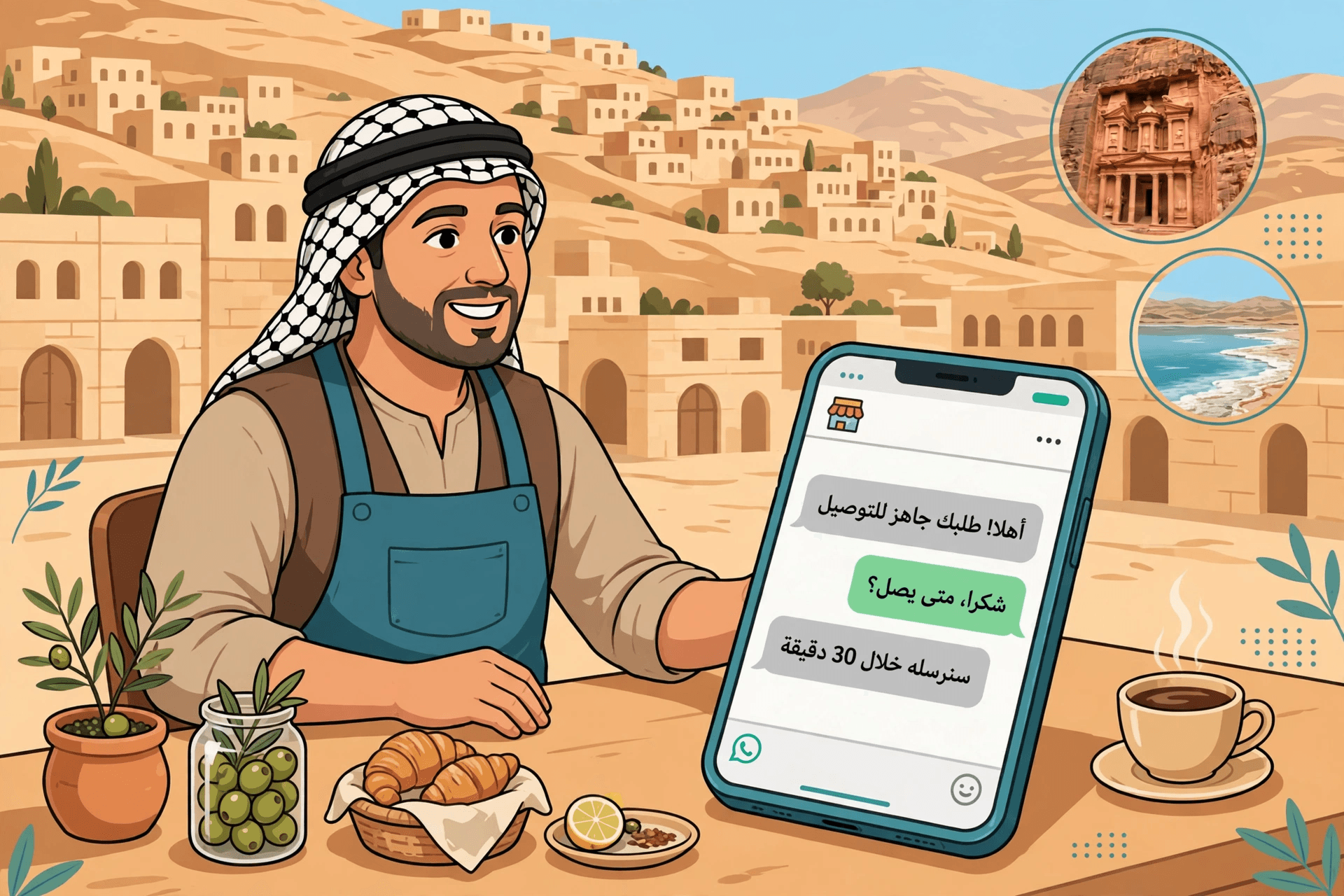
WhatsApp for business in Jordan is the booking desk moved into the thread. A customer in Amman messages a café in Jabal Amman to hold a table for Friday evening; a visitor from Riyadh messages a Petra guide about a sunrise walk through the Siq; a family from Kuwait asks a Dead Sea resort about a day pass and a pickup time. In each case the sale is not a checkout — it is a reservation agreed in conversation: a date, a time, a number of people, and a confirmation the customer can show when they arrive. Jordan is a small market where one thread often serves a café, a tour, and a shop at the same time, and the businesses that do well on WhatsApp are the ones that treat the chat as the reservation book, not as a form to fill in.
Jordanian Arabic first, Modern Standard Arabic for the record
Jordan does not have one business Arabic — it has two registers, and knowing which one to use is the first test of a seller. Jordanian Arabic, the Levant dialect spoken in Amman, Irbid, and Aqaba, is the language of the everyday conversation: warm, direct, full of the small courtesies that keep a booking friendly. Modern Standard Arabic is the language of the written record — the profile, the menu, the price list, the confirmation message the customer screenshots and keeps. A customer will often write in Jordanian dialect to ask, and expect the confirmation back in clear written Arabic they can show at the door. English is the third language in the thread, and it belongs to the visitor: the tourist planning a Petra trip, the business traveller in Abdoun, the GCC guest who writes in English even though they speak Arabic. The practical rule is to answer in the register the customer just used — dialect for the chat, written Arabic for the confirmation, English for the tourist — and never make a customer repeat themselves in a register they did not choose. An agent that reads each message and answers in the same register handles this without a menu, a setting, or a wrong guess, and in Jordan, getting the register right is the first sign the seller is paying attention.
The reservation is the sale
In Jordan, most WhatsApp sales are bookings, and the booking has a shape. The customer asks whether a table, a room, a slot, or a seat is free; the business answers with what is available; the two agree a time; and the business confirms it in one message the customer can keep. The confirmation is the product — it is what the customer shows at the café door, at the clinic reception, at the tour meeting point. The businesses that run this well do three things. They answer the availability question fast, because a customer who waits an hour books somewhere else. They confirm in writing, with the date, the time, and the number of people restated, so there is no argument later about what was agreed. And they remind — a short message the evening before, and a check-in on the day — because a reminded booking is a kept booking. An agent that answers from the seller's own calendar, knows which slots are genuinely free, and hands the conversation to a person when the customer asks for something unusual, keeps the reservation book full without ever inventing a slot the seller never had.
- Confirm in one message, not three. Date, time, number of people, and place, restated together — the customer screenshots it and the booking is settled.
- Remind twice, briefly. A message the evening before and a short check-in on the day turn a maybe into a kept booking, and a customer who cannot come gets a chance to cancel instead of simply not showing up.
- Offer the next slot, not a dead end. When Friday evening is full, the agent offers Saturday lunch or the following Friday — the customer who is offered an alternative books; the customer who is told no walks away.
- Keep the change in the same thread. A moved booking stays in the same conversation, with the new time confirmed in writing, so neither side has to remember what changed.
Tourism runs on the thread
Jordan's visitors plan in chat, and the thread is where the trip is assembled. A guide in Petra answers questions about the walk, the heat, and the meeting point; a camp in Wadi Rum confirms the night, the jeep tour, and the pickup from the village; a resort at the Dead Sea answers a day-pass question from a family already driving down from Amman. The pattern is the same in each case: the visitor asks in English or Arabic, the business answers with the practical detail — where to meet, what time, what is included — and the booking is confirmed in the thread before any money moves. GCC visitors are a second audience inside the same thread: families driving in from Saudi Arabia for a long weekend, Kuwaiti and Emirati guests booking a Dead Sea stay, visitors who message in Arabic and expect the same fast, warm answer a Jordanian customer gets. The
multilingual WhatsApp agent guide explains how one agent follows the customer's language, message by message, so the same inbox serves the Amman regular and the visitor from Riyadh.
The downtown shop and the Amman delivery question
Away from tourism, WhatsApp is the counter of the small shop. A store in downtown Amman — the Balad — photographs a new arrival, a customer asks the price and the size, and the two agree a delivery to Jabal Amman, Abdoun, or Sweifieh. A bakery takes the weekend order in chat; a pharmacy answers a question about a product and arranges a delivery; a furniture shop in Irbid sends photos of a piece and confirms the delivery day. The delivery question in Jordan is a neighbourhood question: Amman is a city of hills and districts, and the customer wants to know whether the seller delivers to theirs, what it costs, and when it arrives. A seller who states the delivery coverage and the charge plainly in the thread gets the order; a seller who is vague about either does not. The agent helps by keeping the facts straight — the neighbourhoods the seller actually covers, the charge for each, and the total the customer agreed to, restated before anything leaves the shop. It never promises a delivery day the seller cannot meet, and it never invents a payment option the seller does not offer.
The rules that keep your number reachable
Three rules decide whether a Jordanian business number stays healthy. First, only write to customers who asked to hear from you — someone who booked with you, asked for a reminder, or gave you their number for that purpose. Second, respect the 24-hour window: once a customer messages you, you have 24 hours of free-form replies; after it closes, you need an approved template message to write first — which is exactly how a booking reminder should be sent anyway. Third, never buy lists of numbers or message strangers in bulk — that is how numbers get blocked and reported, and a blocked number is a closed shop. Neksio is not a bulk or broadcast tool: it answers one-to-one conversations from customers who message you, which is exactly the pattern WhatsApp rewards. The
broadcast rules guide explains opt-ins, templates, and limits plainly.
From one phone to a team inbox
A café with one owner and one phone runs happily on the free WhatsApp Business app: profile, catalog, quick replies, labels for regulars. The moment the business grows past that — a restaurant with bookings coming in at midnight, a tour company with guides answering from Petra and Wadi Rum at the same time, a shop selling in Amman, Irbid, and Aqaba at once — one phone becomes a bottleneck, and the WhatsApp Business Platform (the API) is the step up: several people in one inbox, an agent answering instantly in Jordanian Arabic or English at any hour, and the conversation history in one place instead of scattered across staff phones. The choice is about how many conversations arrive and how fast they need answers, not about how impressive the business looks. Start on the app, move to the API when the phone starts ringing in the thread faster than a person can answer. The
API explained guide walks through what the Platform adds and what it costs to run.
Setting up for Jordan: the short version
Write your business profile in Arabic and English, with your hours, your neighbourhood, and your delivery coverage — because the two questions every Jordanian buyer asks are whether you have the slot and whether you deliver to their area. Photograph your products and your place properly and put them in the catalog with prices, so the booking starts from something real. Put a click-to-WhatsApp link on your Instagram and Facebook pages, where Jordanian customers and GCC visitors discover you — especially if you are a café, a guide, or a shop whose customers find you through photos first. Answer in the register the customer used, confirm every booking in one written message, and remind the evening before. And staff the channel like the booking desk it is: the business that answers the availability question in minutes wins the customer that the business answering tomorrow never meets.
In Jordan, the sale is not made on the website. It is made in the thread — in the customer's register, at the customer's pace, with the booking confirmed before the customer sets out.
WhatsApp for Jordan on Neksio
Neksio is a no-code AI agent that answers one-to-one on WhatsApp from your documents, with human handoff into a unified inbox, on the official Meta API with no ban risk. The agent answers in Jordanian Arabic, Modern Standard Arabic, or English — whichever the customer writes in — from your own prices, catalog, delivery neighbourhoods, and booking rules, at any hour. The Free plan covers 100 AI replies a month on WhatsApp, Starter is $12.99 for 5,000 replies, Growth $16.99 for 15,000 replies including Facebook and Instagram, and Scale $29.99 is unlimited with your own key plus done-for-you onboarding.
100 AI replies a month on WhatsApp, no credit card. Plans on the pricing page.
Frequently asked questions
- Should my business answer Jordanian customers in Jordanian Arabic or Modern Standard Arabic?
- Both — in different places in the same conversation. Jordanian Arabic is the language of the chat itself, the asking and the friendly back-and-forth; Modern Standard Arabic is the language of the written record, the profile, the price list, and the confirmation the customer keeps. An agent that answers in the register each message is written in covers both without a language menu.
- How do I take bookings on WhatsApp in Jordan?
- Answer the availability question fast, agree a date and time in the thread, and confirm it in one written message with the date, time, number of people, and place restated together. Remind the customer the evening before and on the day — a reminded booking is a kept booking.
- Do tourists message Jordanian businesses in English?
- Yes — visitors planning Petra, the Dead Sea, or Wadi Rum usually write in English, and GCC visitors may write in Arabic or English. The same inbox should answer both, in the language each customer writes in, with the practical detail: where to meet, what time, and what is included.
- Do visitors from the Gulf book differently from Jordanian customers?
- The booking itself is the same — a date, a time, a confirmation in writing — but GCC visitors often plan a whole weekend at once: a Dead Sea stay, a Petra day, a restaurant in Amman. Answering in Arabic, confirming each part in the thread, and stating what is included keeps the whole trip in one conversation.
- Can a small shop in downtown Amman run on WhatsApp?
- Yes — that is exactly what WhatsApp suits best in Jordan. Photograph the product, answer the price and size questions in the thread, state which Amman neighbourhoods you deliver to and the charge, and confirm the total before dispatching. A click-to-WhatsApp link on your Instagram or Facebook page turns discovery into a conversation.
- What does a WhatsApp AI agent for Jordan cost on Neksio?
- Free covers 100 AI replies a month on WhatsApp; Starter $12.99 for 5,000 replies; Growth $16.99 for 15,000 replies including Facebook and Instagram; Scale $29.99 unlimited with your own key plus done-for-you onboarding.