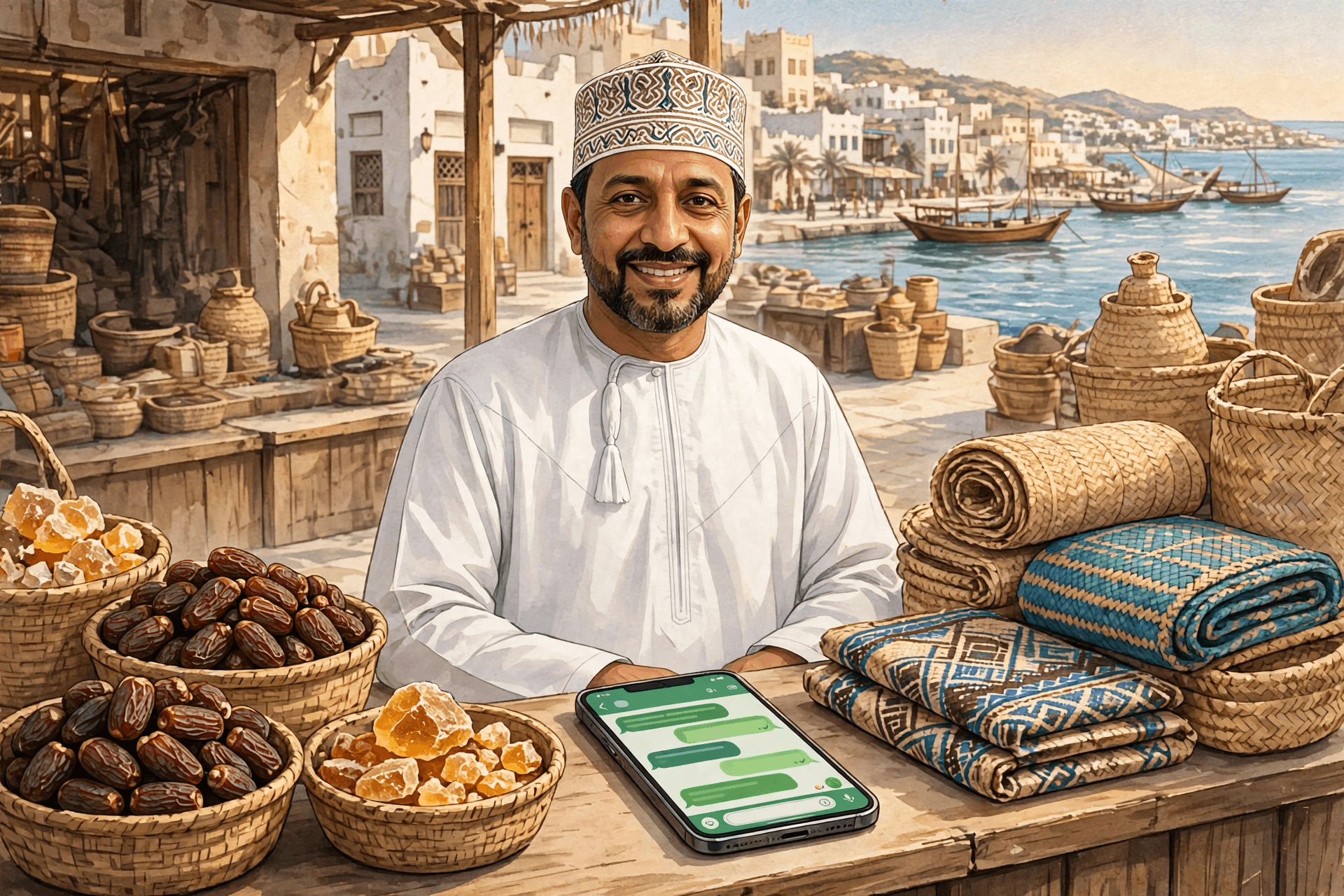
WhatsApp for business in Oman is the order placed in one town and delivered in another. A customer in Sohar messages a shop in Muscat about a frankincense burner and asks whether it can reach her by the weekend; a family in Nizwa orders dates from a seller in the interior and agrees the courier day in chat; a guesthouse in Salalah confirms a room for a visitor driving down from Muscat, and the thread carries the directions, the arrival time, and the pickup from the airport. Oman is a country of long roads and dispersed towns — Muscat on the coast, Salalah far to the south, Sohar to the north, Nizwa in the interior — and the sale is rarely a walk-in. It is a conversation that has to survive the distance: the order agreed, the delivery arranged, and the wait managed in the same thread. The businesses that do well on WhatsApp in Oman are the ones that treat the chat as the order book and the courier's itinerary at once.
Omani Arabic first, English for the expat mix
Oman does not have one business language — it has a spoken register, a written register, and a second audience that writes in English. Omani Arabic, the Gulf dialect heard in Muscat, Sohar, Nizwa, and Salalah, is how the everyday conversation runs: unhurried, courteous, with the small pleasantries that open a sale and keep it friendly. Modern Standard Arabic is for the record that stays — the profile, the price list, the delivery terms, the confirmation a customer screenshots and keeps. English belongs to the expat mix: the large communities of workers from India, Pakistan, Bangladesh, and the Philippines who live and shop in Oman, and the tourists planning a desert camp or a wadi walk. One buyer asks in Omani dialect, a worker in Muscat asks in English, a visitor writes in either — and each expects a reply in the language they just used. The working rule is to mirror the customer's words, then confirm the order in clear written Arabic or English they can keep, and never make a buyer repeat themselves in a language they did not pick. An agent that reads each message and replies in the same tongue needs no menu, no setting, and no guess — and in Oman, matching the language is the first proof the seller is paying attention. The
multilingual WhatsApp agent guide explains how one agent follows the customer's language, message by message, so the same inbox serves the Omani regular, the expat worker, and the visitor from abroad.
The order travels further than the customer
In Oman, the delivery is the sale — or at least, it is where the sale is won or lost. A shop in Muscat sells to a customer in Salalah, a day's drive away; a date seller in the interior ships to a buyer in Sohar; a craft stall in Nizwa's souq sends a piece to a customer who visited once and now orders from home. The customer has three questions, and they ask them in the thread before they pay: do you deliver to my town, what does it cost, and when will it arrive. A seller who answers all three plainly gets the order; a seller who is vague about any of them does not. The delivery charge is part of the price in the customer's mind, not an afterthought, so it belongs in the same message as the product price — agreed once, restated once, and never changed after the customer has said yes. And the wait matters: a customer waiting for a parcel across a long road wants to know it is on its way, and a short message when it leaves the shop is worth more than a tracking link they never open. The agent helps by keeping the facts straight — the towns the seller actually delivers to, the charge for each, the day the parcel leaves, and the total the customer agreed to, restated before anything is dispatched. It never promises a delivery day the seller cannot meet, and it never invents a courier option the seller does not offer. The
logistics agent guide walks through how an agent tracks an order from the thread to the door.
- Name the towns you deliver to, in the thread. Muscat, Sohar, Nizwa, Salalah, and the smaller towns between them — a customer who sees their town named orders; a customer who has to ask whether you deliver there may not bother.
- Quote the delivery charge with the product price. One total, agreed in writing before the customer pays, so the charge is never a surprise at the door.
- Say when it leaves, not just when it arrives. A parcel travelling the long road to Salalah needs a dispatch day the customer can count on, and a message when it is on its way.
- Keep the change in the same thread. A moved delivery day stays in the same conversation, confirmed in writing, so neither side has to remember what changed.
Khareef: when Salalah doubles in a season
Every Omani business that serves Salalah knows the khareef — the monsoon season that turns the southern hills green and draws visitors from across Oman and the Gulf. For a few months, Salalah is a different market: guesthouses fill, restaurants take bookings from families driving down from Muscat, and shops sell to visitors who arrived with no plan and a phone full of questions. The thread is where the season is managed. A guesthouse confirms a room and a pickup time; a tour operator answers questions about the hills, the rain, and the meeting point; a restaurant takes a table booking for a family that will arrive in the evening and wants to know it is held. The surge is short, and the businesses that win it are the ones that answer fast — a visitor who waits a day for a reply books somewhere else, and a visitor who gets an answer in minutes, in their own language, with the practical detail, books with you. The season is also the year's great test of the inbox: the same questions arrive ten times a day, and the seller who answers each one by hand drowns in them. An agent that answers the repeated questions — where to meet, what time, what is included, whether a room is free — from the seller's own facts, at any hour, turns the khareef rush into bookings instead of missed messages, and hands the unusual requests to a person.
What Oman sells in the thread
Oman's trade has a character of its own, and WhatsApp suits it. A frankincense seller in Salalah photographs the resin and the burner, and a customer in Muscat asks which grade and how much; a date grower sends photos of the harvest and agrees the box and the courier day in chat; a potter in Bahla and a weaver in the interior sell pieces to customers who first saw them in a souq and now order from home. Nizwa's souq is the pattern in miniature: a visitor buys once in person, takes the seller's number, and becomes a repeat customer in the thread. Tourism runs the same way. A desert camp confirms a night, a guide answers questions about a wadi walk, a guesthouse in the mountains confirms a room for a visitor driving in from Muscat — and in each case the booking is confirmed in the thread before any money moves, with the practical detail the visitor needs: where to meet, what time, what is included. The
travel agency agent guide explains how one agent handles the whole trip — the booking, the pickup, and the questions in between.
The number is the shop front — keep it clean
Three habits decide whether an Omani business number stays reachable, and they matter most exactly when the inbox is busiest — during khareef, or after a post brings a rush of new numbers. Write only to people who asked to hear from you: someone who ordered from you, asked for a delivery update, or gave you their number for that purpose. Mind the 24-hour window: once a customer messages you, free-form replies are open for a day; after it closes, you write first only with an approved template message — which is how a delivery update or a booking reminder should travel anyway. And never buy lists of numbers or message strangers in bulk — that is how numbers get blocked and reported, and a blocked number is a closed shop. Neksio is not a bulk or broadcast tool: it replies one-to-one to customers who message you, which is exactly the pattern WhatsApp rewards. The
broadcast rules guide explains opt-ins, templates, and limits plainly.
When one phone stops being enough
A shop with one owner and one phone runs happily on the free WhatsApp Business app: profile, catalog, quick replies, labels for regulars. The moment the business outgrows that — a seller taking orders in Muscat, Salalah, and Sohar at once, a guesthouse fielding booking questions at midnight, a date grower whose harvest season fills the inbox for weeks — one phone turns into a bottleneck, and the WhatsApp Business Platform (the API) is the step up: several people sharing one inbox, an agent replying at once in Omani Arabic or English at any hour, and the conversation history in one place instead of scattered across staff phones. The question is how many conversations arrive and how quickly they need replies, not how impressive the business looks. Start on the app, move to the API when the thread starts moving faster than one person can answer. The
API explained guide walks through what the Platform adds and what it costs to run.
Setting up for Oman: the short version
- Write your profile in Arabic and English, with your hours, your town, and the towns you deliver to — the two questions every Omani buyer asks are whether you have the item and whether it reaches their town.
- Photograph your products properly — the frankincense, the dates, the craft, the room — and put them in the catalog with prices, so the order starts from something real.
- Put a click-to-WhatsApp link on your Instagram and Facebook pages, where Omani customers and visitors find you — especially if you sell through photos first.
- Reply in the language the customer used, confirm every order in one written message with the total and the delivery day, and send a short note when the parcel is on its way.
- Treat the channel as the order book it is: the business that answers the delivery question in minutes wins the customer the business answering tomorrow never meets.
In Oman, the customer is rarely across the counter. They are across the road — a long one — and the thread is what carries the sale to them.
WhatsApp for Oman on Neksio
With Neksio, the agent is built without code: it reads your own documents and replies one-to-one on WhatsApp, with human handoff into a unified inbox, on the official Meta API with no ban risk. It answers in Omani Arabic, Modern Standard Arabic, or English — whichever the customer writes in — drawing on your prices, catalog, delivery towns, and dispatch days, at any hour. The Free plan covers 100 AI replies a month on WhatsApp, Starter is $12.99 for 5,000 replies, Growth $16.99 for 15,000 replies including Facebook and Instagram, and Scale $29.99 is unlimited with your own key plus done-for-you onboarding.
100 AI replies a month on WhatsApp, no credit card. Plans on the pricing page.
Frequently asked questions
- Should my business answer Omani customers in Omani Arabic or Modern Standard Arabic?
- Use both, in different places in the same conversation. Omani Arabic carries the chat itself — the asking and the friendly back-and-forth — while Modern Standard Arabic carries the record that stays: the profile, the price list, and the delivery terms the customer keeps. An agent that mirrors the register of each message covers both without a language menu.
- How do I handle delivery to Salalah or Sohar from Muscat?
- State the towns you deliver to and the charge for each in the thread, quote the delivery charge with the product price as one total, and say when the parcel leaves — not just when it arrives. Confirm the total and the dispatch day in one written message before the customer pays, and send a short message when the parcel is on its way.
- What is khareef and why does it matter for my WhatsApp inbox?
- Khareef is the monsoon season that turns Salalah's hills green and draws visitors from across Oman and the Gulf for a few months. Guesthouses, restaurants, and tour operators get a surge of booking questions in the thread, and the businesses that answer fast — in the visitor's own language, with the practical detail — win the bookings. An agent that answers the repeated questions from your own facts turns the rush into bookings instead of missed messages.
- Do tourists and expat workers message Omani businesses in English?
- Yes — the expat communities who live and shop in Oman and the tourists planning a desert camp or a wadi walk usually write in English, while Omani customers write in Omani Arabic. The same inbox should answer both, in the language each customer writes in, with the practical detail: the price, the delivery town, and the day it arrives.
- Can I sell frankincense, dates, or crafts on WhatsApp from Nizwa or Salalah?
- Yes — that is exactly what WhatsApp suits best in Oman. Photograph the product, answer the grade and price questions in the thread, state which towns you deliver to and the charge, and confirm the total and the dispatch day before sending. A visitor who bought once in the souq and took your number becomes a repeat customer in the thread.
- What does a WhatsApp AI agent for Oman cost on Neksio?
- On Neksio, Free covers 100 AI replies a month on WhatsApp; Starter is $12.99 for 5,000 replies; Growth is $16.99 for 15,000 replies including Facebook and Instagram; Scale is $29.99, unlimited with your own key plus done-for-you onboarding.