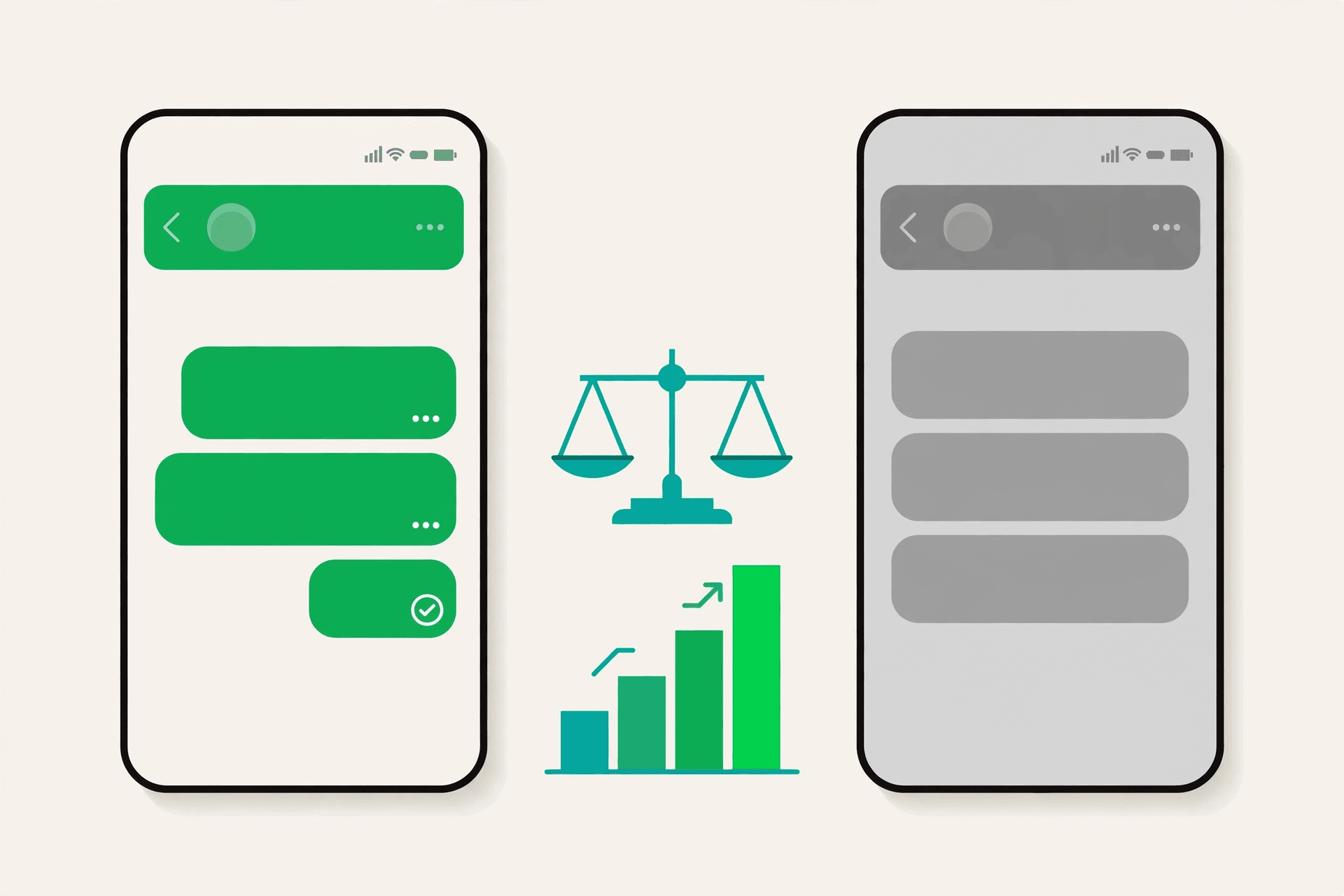
WhatsApp vs SMS marketing is the wrong question if it is asked as a popularity contest, and the right question if it is asked as a budget decision: which channel gets a message read, answered, and acted on, for what it costs you to send it? SMS reaches any phone with no app to install. WhatsApp carries richer conversations, but only inside Meta's rules — opt-in, approved templates, and a 24-hour reply window. This comparison works through the four things that actually decide the answer: what each channel can do, what it costs, how you know it was read, and what the rules allow. The numbers in the worked examples are illustrative, because real rates vary by country and provider; the method is the part worth keeping, because it works with whatever rates you are actually quoted.
The comparison at a glance
- Reach: SMS works on any mobile phone, no app needed. WhatsApp needs the app installed and an account — which most of your customers already have, but not all of them.
- Format: SMS is plain text, roughly 160 characters per segment. WhatsApp carries images, buttons, lists, catalogs, and voice notes in the same thread.
- Cost: SMS is usually priced per segment sent. WhatsApp is usually priced per conversation or per template message, and the rate depends on the message category and the customer's country.
- Replies: WhatsApp is built for two-way conversation. SMS can receive replies, but threading them into a support conversation takes extra tooling.
- Rules: both channels need consent. WhatsApp adds template approval and a 24-hour window for free-form replies; SMS adds carrier and country rules that vary by market.
What each channel actually is
SMS is the phone network's own messaging: a text arrives in the native inbox of any mobile, smartphone or not, with nothing to download and no account to create. That universality is its whole advantage. Its limits are just as plain: plain text only, a segment limit that splits long messages, no read receipts you can rely on, and no way to know whether the number still belongs to the person you think it does.
WhatsApp Business messaging runs through the official WhatsApp Business API. A business sends template messages to customers who have opted in, and once a customer replies, the business has a 24-hour window in which it can send free-form messages. An AI agent can answer inside that window, and the conversation can carry photos, documents, buttons, and catalog items. The trade is control for capability: Meta approves the templates, enforces the window, and rates the quality of the messages a business sends. A business that treats WhatsApp like SMS — blasting the same message to everyone — will find its templates rejected and its quality rating falling.
The pricing mechanics behind WhatsApp's per-message charges are explained in the WhatsApp per-message pricing guide, and the template rules in the message templates guide.
Open rates: what you can measure, and what you cannot
You will see confident open-rate figures quoted for both channels — very high numbers for SMS, very high numbers for WhatsApp. Treat any such figure with suspicion unless it names its source, its market, and its measurement method, because the two channels do not even measure the same thing. SMS delivery reports tell you the message reached a handset; they do not tell you it was read. WhatsApp shows read receipts when the customer has them switched on, and template messages report delivery and reads through the API — but only for customers who have receipts enabled and only inside conversations the rules allow you to start.
So compare the channels structurally instead of by a borrowed percentage. SMS wins on certainty of arrival: it lands in the one inbox every phone has, and there is no algorithm deciding whether it appears. WhatsApp wins on certainty of attention once it arrives: the message sits in the app people check constantly, attached to a business profile with a name and a photo, and the customer can reply in the same thread instead of switching apps. The practical test is not which channel has the higher headline rate; it is which channel's replies turn into orders, bookings, or resolved support tickets. That is a number your own first campaign can give you, and no industry average can.
The cost math, worked out
Cost per message sent is the wrong unit. The unit that matters is cost per conversation that actually happens — a message read and replied to — because an unread message is money spent on nothing. Work it out in three steps: what one message costs, how many of them get a reply, and what the reply is worth.
Example 1: a one-off announcement to 1,000 customers
Assume, for illustration only, SMS at $0.02 per segment and a WhatsApp template message at $0.03 per message — your real rates will differ by country and provider, so replace these with your quotes before deciding anything. Sending to 1,000 customers costs $20 by SMS and $30 by WhatsApp. Now suppose 5% of SMS recipients reply or act, and 15% of WhatsApp recipients do, because the WhatsApp message carries a button and a product image. That is 50 responses for $20, or $0.40 per response, against 150 responses for $30, or $0.20 per response. The channel that looked 50% more expensive per message is half the price per response. Change the reply rates and the answer flips — which is exactly why the reply rate, not the per-message price, is the number to test first.
Example 2: a month of support conversations
Support is where the comparison changes shape entirely. An SMS thread cannot carry a photo of a faulty product, a tracking link with a button, or a catalog item — each of those needs another channel, and every channel switch loses customers. A WhatsApp conversation can carry all of them in one thread, and an AI agent can answer the routine half of those conversations without a human touching them. That is why the honest cost comparison for support is not SMS versus WhatsApp per message; it is the cost of the messages plus the cost of the human time each channel needs. A channel that costs more per message but halves the human handling time usually wins the month.
The same worked-example method, applied to the full cost of running a WhatsApp agent including human handling time, is in the WhatsApp chatbot cost worked examples.
Reply quality: where the channels diverge most
A reply is not a reply. SMS replies arrive as plain text with no context attached — no order number, no product, no conversation history unless your tooling stitches it together. WhatsApp replies arrive inside a thread that already holds the order, the catalog item, and everything the customer said before. That context is what makes an AI agent useful: it answers from your policies and your product data, in the same conversation, instead of asking the customer to repeat themselves. For a one-way announcement — a delivery notice, a one-time code, an appointment reminder — the difference barely matters. For anything that might turn into a conversation, it is the whole decision.
The rules that decide for you
Both channels require consent, and both punish businesses that skip it. SMS consent is usually collected at checkout or signup, and every market has its own rules about what you may send and how opt-out must work. WhatsApp consent is stricter in practice: customers opt in to a business, marketing messages need an approved template, and outside the 24-hour window you cannot send a free-form message at all. Those rules are a feature, not a burden — they are the reason WhatsApp inboxes are not full of spam, and the reason customers still read what arrives there.
One rule matters more than the rest for a small business choosing a tool: Neksio is not a bulk or broadcast tool. WhatsApp on Neksio means 1:1 replies to customers who message you, and approved template messages to customers who opted in — order updates, reminders, and follow-ups they asked for. It does not send bulk blasts, broadcast lists, or unsolicited outreach, and any tool that promises to do that on WhatsApp is promising to get your number restricted. If your plan depends on blasting, SMS — with proper consent and your provider's rules — is the honest channel for it, and WhatsApp is the wrong one.
What counts as a broadcast, and where the line sits, is covered in the WhatsApp broadcast rules guide.
When SMS wins, when WhatsApp wins
- Choose SMS when the message must reach everyone, including customers without WhatsApp: one-time codes, delivery notices, urgent alerts, and audiences with older phones or low app usage.
- Choose SMS when the message is short, one-way, and time-critical — the native inbox has no app to open and no window to expire.
- Choose WhatsApp when the message might turn into a conversation: product questions, support, bookings, and anything where the customer may reply with a photo or a follow-up question.
- Choose WhatsApp when the message needs more than text: a product image, a payment link with a button, a catalog item, or a document.
- Choose WhatsApp when you want the same thread to carry the sale, the order update, and the support question that follows it.
Most businesses end up using both, with a clear split: SMS for the alerts that must reach everyone, WhatsApp for the conversations that earn the next order. The split only works if each channel is used for what it is good at. Sending marketing blasts on WhatsApp breaks the rules that keep it readable; sending a support conversation over SMS throws away the context that makes it cheap.
How to decide with your own numbers
- Get your real rates: one SMS segment price and one WhatsApp template price, for your customers' countries, from your actual providers.
- Run one small campaign on each channel to the same kind of list — same offer, same week — and measure replies and orders, not sends.
- Divide total spend by responses, then by orders, for each channel. The winner is the lower cost per order, whatever the per-message prices said.
- Add the human time: minutes spent handling replies per channel, priced at your team's hourly cost. A channel that needs hand-holding on every reply is more expensive than its message price suggests.
- Re-test every quarter. Rates change, audiences move, and the channel that won last year is not guaranteed to win this one.
What WhatsApp costs to run on Neksio
On Neksio, the Free plan covers 100 AI replies a month on WhatsApp — enough to test the comparison on your own customers instead of trusting this article's illustrative numbers. Starter at $17.99 a month covers 5,000 replies, Growth at $24.99 a month covers 15,000 replies and adds Facebook and Instagram, and Scale at $49.99 a month is unlimited replies with your own key, plus done-for-you onboarding. Meta's per-message charges sit on top of the plan, at Meta's rates for your market, so the plan covers the agent and the replies while Meta bills the messages themselves. No plan needs code, every plan runs on the official WhatsApp API, and no plan sends bulk messages.
100 AI replies a month on WhatsApp, no credit card. Run one small campaign, measure replies and orders, and let your own numbers settle the WhatsApp vs SMS question. Full detail on the pricing page.
Frequently asked questions
- Is WhatsApp or SMS better for marketing?
- It depends on the job. SMS wins for short, one-way, must-reach-everyone messages like one-time codes and delivery notices. WhatsApp wins for anything that might turn into a conversation — product questions, support, bookings — because it carries images, buttons, and the full conversation history in one thread. Most businesses use both, split by the job.
- Is WhatsApp marketing cheaper than SMS?
- Per message, SMS is usually cheaper; per response, WhatsApp often wins, because its messages carry buttons and images that earn more replies. The honest comparison is cost per response or cost per order from your own small test campaign, using the rates your providers actually quote you — not a headline per-message price.
- What are the open rates for WhatsApp vs SMS?
- Neither channel publishes a single reliable open rate, and the two do not measure the same thing: SMS delivery reports show arrival at a handset, not a read, while WhatsApp read receipts only work when the customer has them enabled. Compare them on your own campaign data — replies and orders per message sent — rather than on a borrowed percentage.
- Can I send bulk marketing messages on WhatsApp?
- No — not legitimately. WhatsApp requires customer opt-in and approved templates for marketing messages, and bulk blasts or broadcast lists to people who did not ask for them will get templates rejected and numbers restricted. Neksio is not a bulk tool: it handles 1:1 replies and approved template messages to opted-in customers only.
- Do I need consent to send WhatsApp or SMS marketing?
- Yes, both channels require consent, and the rules vary by market. On WhatsApp, customers opt in to your business and marketing messages need an approved template; on SMS, consent is usually collected at checkout or signup, with opt-out rules set by each country's regulations. Keep a record of how each customer opted in.
- How much does WhatsApp marketing cost on Neksio?
- Free covers 100 AI replies a month on WhatsApp. Starter is $17.99 a month for 5,000 replies, Growth is $24.99 for 15,000 replies plus Facebook and Instagram, and Scale is $49.99 for unlimited replies with your own key and done-for-you onboarding. Meta's per-message charges are separate, at Meta's rates for your market.