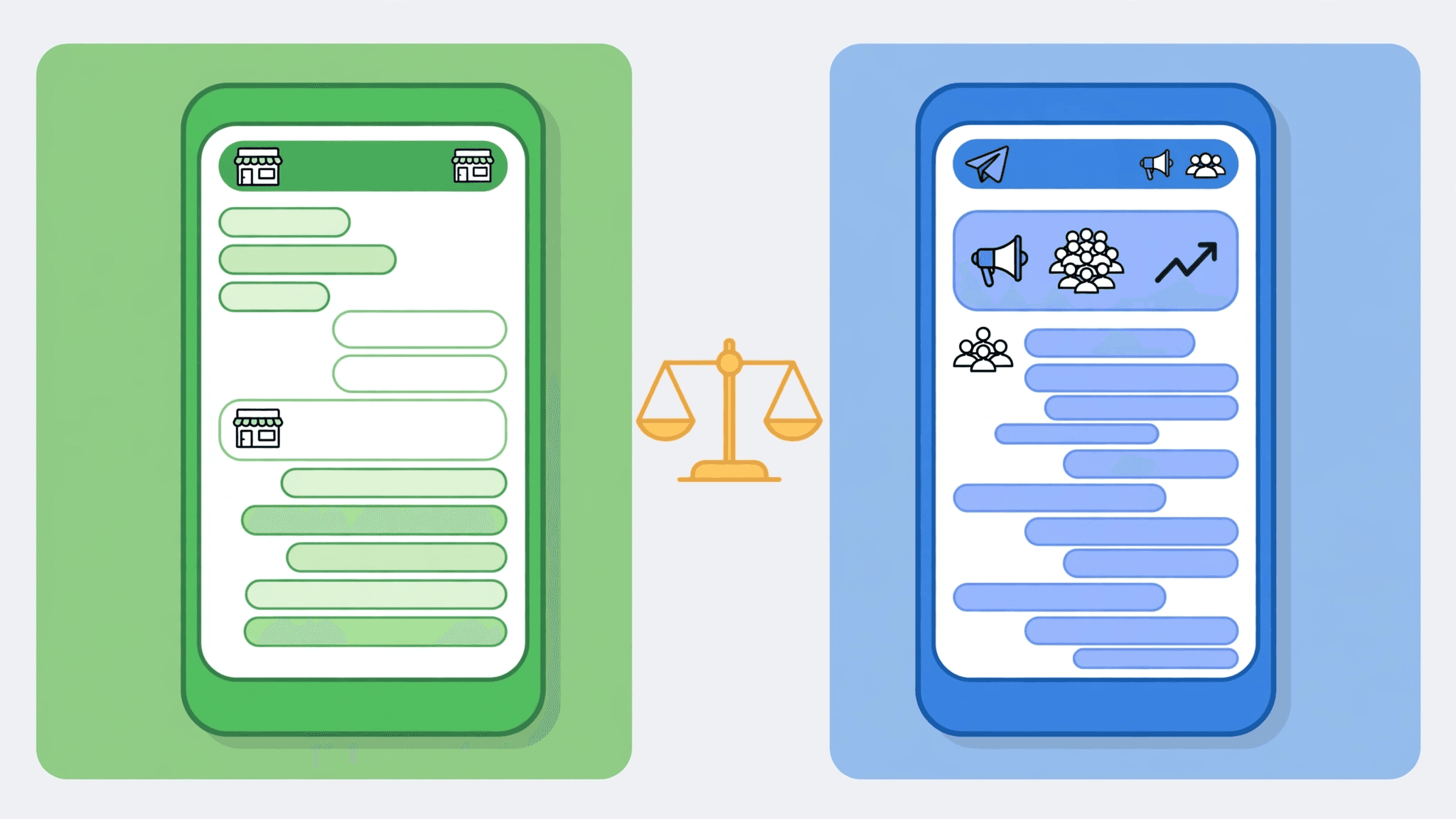
WhatsApp vs Telegram for business is usually argued as a feature list: who has bigger groups, who has better bots, who has channels. That is the wrong argument, because the two apps are not two versions of the same thing. Telegram is a public square — a place to publish to thousands at once, run a community, and let anyone build a bot. WhatsApp is a front counter — a place where one customer at a time asks a question and expects an answer. The feature list only matters after you answer the question that decides the comparison: where do your customers already live? A channel your customers never open is a channel that does not exist, however good its features are. This comparison starts with that map, then works through what each app is actually built for, where each one wins, what automation looks like on each, and how to run both without hiring a second team.
Start with the map, not the feature list
Every business has a home app — the one its customers open without thinking. In much of Latin America, India, the Middle East, and parts of Europe, that app is WhatsApp: it is where the family group lives, where the plumber sends the quote, where the customer already expects a business to answer. In parts of Eastern Europe and Central Asia, and among crypto, gaming, and tech audiences almost everywhere, Telegram is the default instead: it is where the community lives, where the announcement channel lives, where people go to follow rather than to chat. Neither pattern is universal, and both can be true inside one customer base — a business selling to developers in Berlin and to families in São Paulo is serving two different home apps at once.
The practical way to read the map is to ask your own customers, not to trust a global ranking. Look at the last twenty customer conversations you had: which app did they arrive on? Check your own phone — which app do your customers message you on when they find you themselves, with no link and no prompt? If the answer is overwhelmingly one app, the comparison is nearly settled before it starts, and the other app is a second channel, not a replacement. If the answer is split, you have a two-channel business and the rest of this article is about how to divide the work between them. The mistake is to pick the app you like, or the app with the longer feature list, and then try to drag your customers onto it. Customers do not move apps for a business. Businesses move to where the customer already is.
What Telegram actually is: a channel, a group, and a bot platform
Telegram's shape explains everything else about it. A Telegram channel is a one-to-many broadcast: a business posts, subscribers read, and there is no reply-all chaos because subscribers cannot reply in the channel itself. A channel can grow to a very large audience with no practical ceiling, and posting to it costs the business nothing beyond the time to write the post. A Telegram group is the opposite shape — a many-to-many room where members talk to each other, which makes it a community rather than an audience. And underneath both sits Telegram's bot platform: anyone can build a bot through an open API, with no approval queue and no template review, and bots can live inside groups, answer commands, take payments, and run small apps.
WhatsApp is shaped the other way round. Its basic unit is the one-to-one chat, and everything else is built to protect that unit: groups are capped and private, broadcast lists only reach people who saved your number, and business messaging runs through the official API with opt-in, approved templates, and a 24-hour window for free-form replies once a customer messages you. That structure is a deliberate trade — reach is restricted so that the chat window stays a place customers trust — and it is the reason WhatsApp is where conversations close, while Telegram is where audiences gather. Neither shape is better in the abstract. A channel that publishes is not a counter that answers, and a counter that answers is not a channel that publishes.
The WhatsApp side of those rules — opt-in, templates, and the 24-hour window — is explained in the 24-hour window guide and the message templates guide.
Where Telegram wins: reach without permission, and community at scale
Telegram's clearest win is publishing. If your business has something to say to many people at once — a price list update, a new collection, a class schedule, a weekly deal — a Telegram channel delivers it to every subscriber with no opt-in form, no template approval, and no per-message bill. The subscriber chose to follow the channel, and that single choice covers every post you will ever send. Compare that with WhatsApp, where each marketing message needs opt-in and an approved template, and where a broadcast list quietly stops working for anyone who never saved your number. For the job of announcing, Telegram is simply the cheaper, freer tool.
Its second win is community. A Telegram group can hold a whole customer community — hundreds or thousands of members talking to each other, answering each other's questions, posting photos of what they bought — and the business mostly watches and steers. That is a kind of marketing no one-to-one channel can do: customers selling the product to each other. It fits businesses whose customers like belonging to something — a gym, a gaming store, a course, a fan community, a local club. WhatsApp has communities too, but they are built from private groups with an announcement layer on top, and they feel like a neighbourhood; Telegram groups feel like a town square. If your customers want to talk to each other, not just to you, Telegram is where that happens.
Its third win is the bot platform. Because Telegram's bot API is open, a small business can ship a bot in a weekend: a menu bot, a booking bot, a bot that answers the five most common questions, a bot that takes an order inside the chat. No application, no business verification, no review queue. That freedom is real, and it is also the reason Telegram bots vary so wildly in quality — there is no one checking. But for a business that wants to experiment cheaply, Telegram is the place to try an idea before committing to the stricter, more expensive WhatsApp API.
Where WhatsApp wins: the conversation that closes
WhatsApp's win is the opposite job: the one-to-one conversation where money changes hands. A customer asks about a product, the business answers, the customer asks a follow-up, the business sends a photo, the customer confirms, the order is placed — all in one thread, with the order, the address, and everything said before already on screen. Telegram can host the same exchange in principle, but in practice the customer who wants to buy writes on the app where they already talk to businesses, and for most of the world that app is WhatsApp. The buying conversation belongs to the app the customer trusts with their money, and trust is the one thing that cannot be copied from a feature list.
That trust is structural, not sentimental. A WhatsApp business profile is tied to a verified phone number, shows a business name and catalogue, and carries the signals — read receipts, online presence, a number the customer can call — that make a stranger feel like a real shop. The rules that restrict WhatsApp marketing are the same rules that create that trust: because businesses cannot blast the chat window, customers still believe what arrives in it. An AI agent can answer inside that thread from your own documents — prices, policies, opening hours — and hand over to a human when the question needs one. That is the job WhatsApp owns, and it is the job that pays: questions answered, orders taken, problems solved, one customer at a time.
WhatsApp also wins the jobs where the customer needs to be found, not to find you. An appointment reminder, a delivery update, an order confirmation — a message that must reach one specific person at one specific time — works on WhatsApp because the message lands in a chat the customer already reads. On Telegram the same message goes to a channel the customer may check tomorrow, or to a bot chat the customer may have muted. Urgency belongs to the private channel. If the message matters to one person and it matters now, it goes on WhatsApp.
The automation gap: open bots vs a gated API
Automation is where the two apps differ most in spirit. Telegram's bot platform is open and permissionless: build a bot, publish it, and anyone can talk to it. The ceiling is your own engineering, and the floor is nothing at all. That makes Telegram the better place to experiment — a booking bot, a quiz bot, a support bot that answers from a FAQ — because the cost of trying is an afternoon, not an application.
WhatsApp automation runs through a gated API, and the gate is the point. A business gets API access, proves opt-in, writes templates that Meta approves, and answers inside a 24-hour window after the customer messages. In return the automation runs on the channel customers actually answer on, with a verified business identity behind it, and the customer knows the reply is from the business rather than from a stranger's bot. An AI agent on WhatsApp is a standing answerer for real customer questions; a Telegram bot is often a small app the customer has to discover first. It is worth saying plainly what WhatsApp automation is not. It is not a newsletter machine, and Neksio is not a bulk or broadcast tool: it handles 1:1 replies to customers who message you, and approved template messages to customers who opted in — order updates, reminders, and follow-ups they asked for. The same rule applies in reverse on Telegram: a bot that spams a group will be removed by the group's members faster than any platform rule could manage it.
How WhatsApp business access works is covered in the WhatsApp Business API guide, and the difference between a follow-up and a broadcast in the broadcast rules guide.
The cost question, honestly
Telegram is free for almost everything a small business does with it: channels, groups, and bots cost nothing to run, and there is no per-message charge from Telegram. That is a genuine advantage, and for a business whose main job is publishing, it can be the whole decision. WhatsApp has a visible cost: Meta charges per message on the business API, on top of whatever platform runs the agent, and those charges vary by market. What Telegram's free price tag hides is the cost of the audience: a channel with nobody in it is free and useless, and building that audience takes the same content work that any publishing channel takes.
Illustrative example: a shop splitting the work
Take a small online shop with a thousand past customers — the figures below are illustrative, for the method only; replace them with your own numbers before deciding anything. Suppose the shop posts a weekly offer to a Telegram channel and answers order questions on WhatsApp. The Telegram side costs nothing to send, but suppose only 200 of the 1,000 customers ever joined the channel, so each post reaches a fifth of the list. The WhatsApp side has a per-message cost from Meta plus the agent platform plan, but suppose it reaches the customers who actually write in — the ones about to buy — and an AI agent resolves most of their questions without a human. The cheap channel reaches the audience you built; the expensive channel reaches the customer who is already at the counter. Neither number decides the question on its own. Run it with your own audience size, your own reply volume, and Meta's rates in your market — the answer flips with the size of your Telegram audience, and that is the point.
The decision rule: match the channel to the business
The comparison settles fastest when you sort your business into the shape it already is, rather than comparing features in the abstract.
- Local services — salon, clinic, repair shop, restaurant: WhatsApp first. Customers book, ask, and confirm one at a time, and they need a reminder that reaches one person at one time. Telegram is a noticeboard you may never need.
- Ecommerce with repeat buyers: both, split by job. Telegram channel for the weekly drop and the offer; WhatsApp for order questions, delivery problems, and the conversation that closes the sale.
- Content and community businesses — courses, creators, gaming, crypto: Telegram first. Your product is the audience itself, and a channel plus a group is the business. WhatsApp is the support desk behind it, for the customers who need a private answer.
- B2B and high-trust services — consultants, agencies, law firms: WhatsApp first. A client wants a private conversation with a named person, a quote they can forward, and a thread they can search. A Telegram channel adds little and can look unserious.
- Businesses whose customers are split across regions: both, and let the customer choose. Put the WhatsApp button and the Telegram link side by side and watch which one gets tapped — your customers will vote with their thumbs.
Notice what the rule never says: it never says to pick one and delete the other. The businesses that lose this comparison are the ones that treat it as a war. The ones that win it treat it as a division of labour — and they let the customer's own behaviour, measured over a month, settle the split.
Run both without doubling your work
If the decision is both, the fear is doing twice the work. The fix is to give each channel one job and refuse to let the jobs bleed into each other. The Telegram channel publishes: one post a week, written once, announcing the offer or the news — and it never answers support questions in public, because a channel is not a helpdesk. WhatsApp answers: every question, order, and problem, in a one-to-one thread, with an AI agent resolving the routine ones from your documents and a human taking the rest. The two meet in one place: the Telegram channel post ends with a line pointing to WhatsApp for questions and orders, and the WhatsApp thread can point a curious customer at the Telegram channel for news and offers. Each channel advertises the other, and neither tries to do the other's job.
That split also keeps the workload honest. A channel post is a single piece of writing a week, not a conversation you have to staff. A WhatsApp thread is a conversation, but it is the conversation you would have had anyway — by phone, by email, or in person — now answered faster because the agent handles the routine half. If running both means answering the same question twice in two apps, the split is wrong: the question belongs on WhatsApp, and the Telegram channel should have pointed there in the first place.
Run the comparison on your own customers
Do not settle this question with an article — including this one. Settle it with a small, honest test. For one month, publish the weekly offer on your Telegram channel and answer questions on WhatsApp, and write down what actually happens: how many customers joined the channel, how many read the post, how many questions arrived on WhatsApp, how many of those turned into orders, and how many minutes your team spent on each channel. Then ask the question the other way round: if you had put the same offer only on WhatsApp, how many of the Telegram readers would ever have seen it? The answer is usually the decision — not because one app won, but because your customers told you where they live.
What WhatsApp costs to run on Neksio
On Neksio, the Free plan covers 100 AI replies a month on WhatsApp — enough to test the chat side of this comparison on your own customers instead of trusting this article's illustrative numbers. Starter at $12.99 a month covers 5,000 replies, Growth at $16.99 a month covers 15,000 replies and adds Facebook and Instagram, and Scale at $29.99 a month is unlimited replies with your own key, plus done-for-you onboarding. Meta's per-message charges sit on top of the plan, at Meta's rates for your market. Telegram stays yours — Neksio does not replace your channel or your group, it adds the chat window that closes the sale next to them. No plan needs code, every plan runs on the official WhatsApp API, and no plan sends bulk messages.
100 AI replies a month on WhatsApp, no credit card. Answer real customer questions in chat while Telegram keeps the audience, and let your own month of data settle the WhatsApp vs Telegram question. Full detail on the pricing page.
Frequently asked questions
- Can I use Telegram for business instead of WhatsApp?
- For publishing and community, yes — a Telegram channel reaches subscribers free, with no template approval and no per-message charge, and a group can hold a whole customer community. For one-to-one selling and support, no: the buying conversation, the appointment reminder, and the order update belong on WhatsApp, where the customer already talks to businesses and trusts the thread. Most businesses that use both split the jobs, not the customers.
- Is Telegram free for business use?
- Telegram charges nothing for channels, groups, or bots, and there is no per-message fee — that is a genuine advantage over WhatsApp, where Meta charges per message on the business API. What is not free is the audience: a channel only reaches the subscribers you have built, and building that audience takes the same content work any publishing channel takes.
- Can a Telegram bot replace a WhatsApp AI agent?
- Not for the same job. A Telegram bot is easy to build through an open API and is good at menus, bookings, and answering inside a channel or group. A WhatsApp AI agent answers one-to-one customer questions from your own documents on the app customers already use to buy — with a verified business identity and a 24-hour reply window. The bot is a small app customers discover; the agent is a standing answerer on the channel they already open.
- Should I run a Telegram channel and WhatsApp together?
- If your customers are split across the two apps, yes — with one job each. The Telegram channel publishes the weekly offer or news and points customers to WhatsApp for questions and orders; WhatsApp answers one-to-one and points curious customers at the channel. If running both means answering the same question twice, the split is wrong: the question belongs on WhatsApp.
- Does Telegram have anything like WhatsApp's 24-hour rule?
- No. Telegram has no 24-hour reply window, no opt-in requirement, and no template approval — a channel can post whenever it likes and a bot can reply to anyone who starts it. That freedom is why Telegram is good for publishing and why WhatsApp is trusted for conversations: WhatsApp's rules are what keep its chat window a place customers still open.
- What does WhatsApp cost on Neksio?
- Free covers 100 AI replies a month on WhatsApp. Starter is $12.99 a month for 5,000 replies, Growth is $16.99 for 15,000 replies plus Facebook and Instagram, and Scale is $29.99 for unlimited replies with your own key and done-for-you onboarding. Meta's per-message charges are separate, at Meta's rates for your market.