Every AI chatbot for small business promises the same thing: never miss a customer again. Most of them deliver it in the wrong place — a widget on a website your customers visit once, while the actual conversations happen in WhatsApp, Instagram DMs and Facebook Messenger. This post is the gateway guide: what a small-business AI chatbot should do, where it should live, what it costs honestly, and where to read deeper once you have picked your channel.
The one decision that matters most is the channel. Your customers already message businesses on WhatsApp. An AI chatbot that lives there meets them where they are; one that lives only on your website waits for them to come to you. For most small businesses, the channel question answers itself — and the rest of this post assumes WhatsApp first, with the other channels as backup.
What a small-business chatbot must do
- Answer the repeat questions instantly, in the customer's language, from your own documents — not from generic internet knowledge.
- Do small jobs in the conversation: book appointments, take orders, collect details, send quotes.
- Hand over to a human with full context the moment it cannot help. No dead ends, no "please repeat your problem".
- Run on the official channel APIs. Unofficial WhatsApp automation gets numbers restricted or banned — the cheapest tool becomes the most expensive mistake.
Website widget vs messaging channels
The classic small-business chatbot is a bubble in the corner of the website. It has one structural problem: the customer has to be on your website, in that moment, to use it. Messaging channels invert this. WhatsApp is already open on your customer's phone. The conversation starts there, continues there, and the booking or order completes there. Open rates and reply rates on messaging crush website widgets for the same reason texting crushes email: it is where attention already lives.
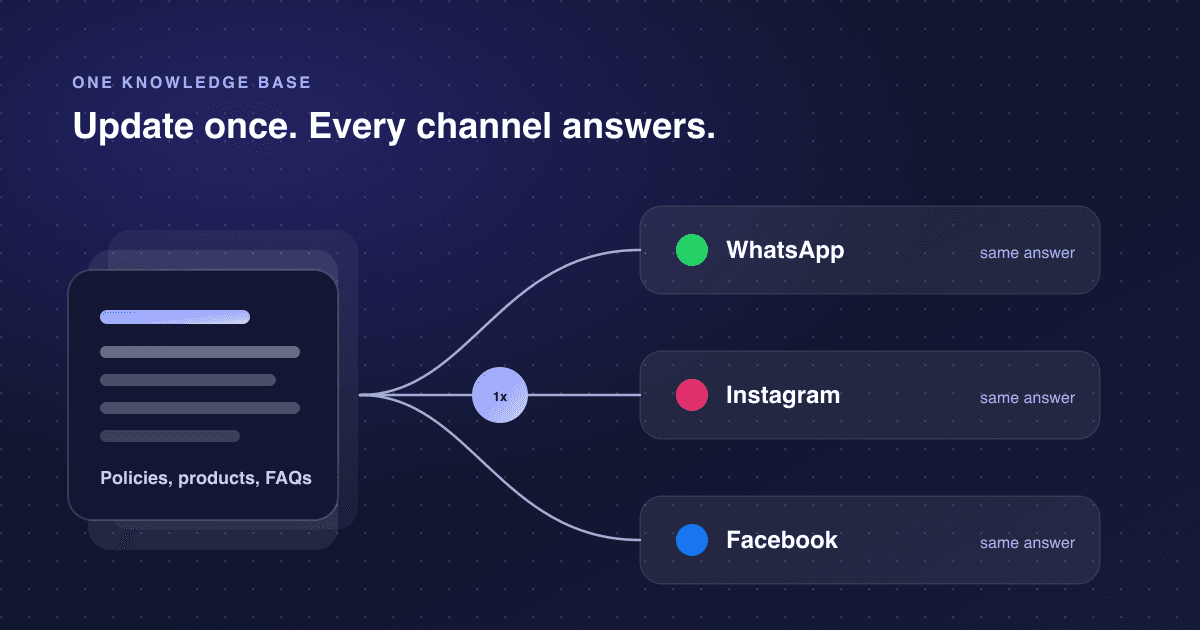
If you run on several channels at once, one agent can cover them all: one AI agent for WhatsApp, Instagram and Facebook explains the multi-channel setup.
What it costs, honestly
A small business can start at zero marginal cost: Neksio's Free plan runs a WhatsApp agent with 100 AI replies a month, no credit card — enough to cover the repeat questions for a typical small operation. Growth at $11.99/month gives 15,000 replies plus Facebook and Instagram for businesses with real volume. The Starter plan at $8.99 covers 5,000 replies, and Scale at $29.99 is unlimited with your own key plus done-for-you onboarding. On top of any platform, Meta bills its own WhatsApp conversation fees directly — that applies to every provider on the official API.
The full cost breakdown — free tiers, flat vs per-message models — is in WhatsApp AI agent pricing.
Where to go from here
Pick your next read by your situation: the WhatsApp AI agent guide if you want the full what-and-how, how to set up a WhatsApp AI agent when you are ready to build, and the best WhatsApp AI chatbots comparison if you are still choosing between tools.
100 AI replies a month on WhatsApp. Plans on the pricing page.
Pertanyaan yang sering diajukan
- What is the best AI chatbot for a small business?
- The best one lives where your customers already message you — usually WhatsApp — answers from your own business documents, hands over to a human when stuck, and runs on the official API. Neksio's Free plan covers this with 100 AI replies a month on WhatsApp, no credit card.
- How much does an AI chatbot cost for a small business?
- You can start free: Neksio Free is 100 AI replies a month on WhatsApp. Starter is $8.99 for 5,000 replies, Growth is $11.99 for 15,000 replies plus Facebook and Instagram, Scale is $29.99 unlimited with your own key. Meta's WhatsApp conversation fees are billed separately by Meta.
- Do I need a website chatbot or a WhatsApp chatbot?
- For most small businesses, WhatsApp: customers are already there, and open and reply rates beat website widgets. A website widget only works when the customer is on your site in that moment.
- Can a chatbot really replace hiring support staff?
- It replaces the repetitive part — repeat questions, intake, booking — which is most of the volume. Judgment calls, complaints and complex cases still go to a human, which is why the handoff feature matters more than any AI claim.
- Is it risky to let AI talk to my customers?
- The risks are invented answers and no escape hatch. Both are solved: grounding answers in your own documents stops invention, and human handoff with full context handles everything else. Avoid unofficial WhatsApp automation tools — those carry the real risk, a banned number.