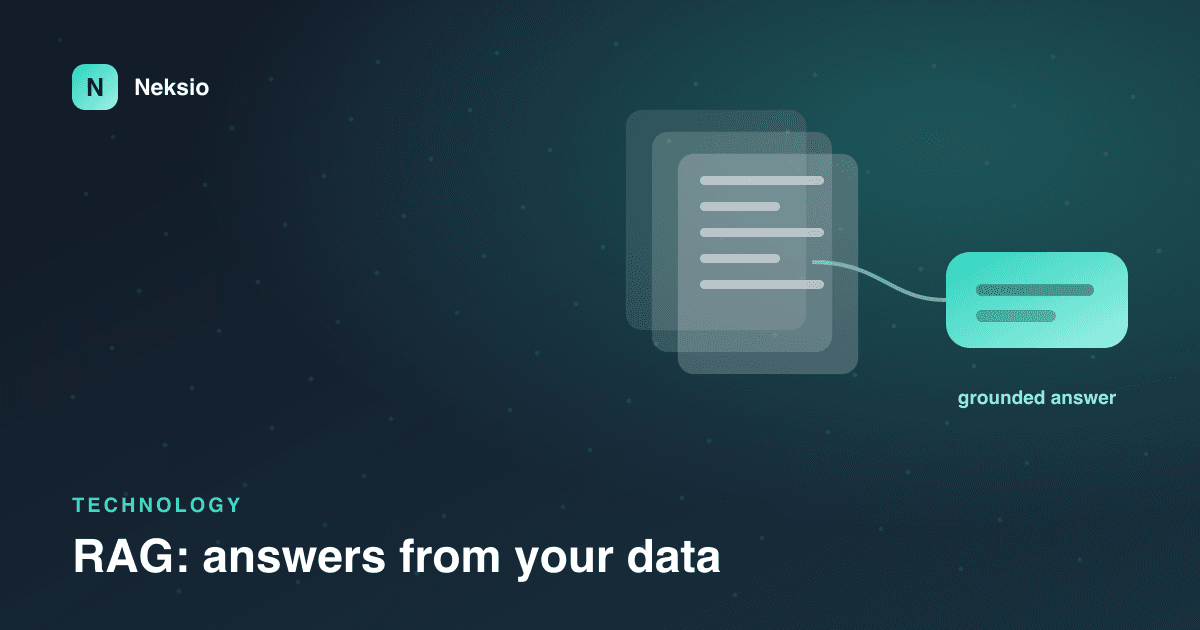
To train an AI agent on your documents means teaching it to answer from your business's own content — price lists, FAQs, policies, product sheets — instead of guessing from general knowledge. The technique is retrieval-augmented generation (RAG): when a customer asks a question, the agent searches your uploaded documents, pulls the relevant passages, and answers from them. The quality of the answers is almost entirely decided by the quality of the documents you upload.
Start with the five documents every business already has
A FAQ sheet answering your twenty most-asked questions; a price list or rate card with current prices and what is included; a policies document (hours, delivery, returns, cancellations); a services or products overview in plain language; and a contact/escalation sheet (who handles what, when a human must step in). Upload these five and most customer questions are already covered. The full explanation of the technique behind this is in the
RAG guide — this post is the practical version: what to upload and how to write it.
What makes a good source document
Good source documents are current, specific, and written the way customers ask. “Delivery is $5 within the city, free over $50, 2–4 business days” beats a vague “fast delivery available.” Use real numbers, real names, and real conditions. Write answers to questions, not marketing copy — a brochure that says “world-class service” contains nothing an agent can answer with. Headings help retrieval: a document organized as questions and answers is retrieved far more accurately than one long wall of prose.
What not to upload
Outdated price lists are the top source of wrong answers — an old PDF with last year's prices will be quoted confidently. Scanned images without text, internal-only documents (staff salaries, supplier costs), and contradictory versions of the same policy (“returns in 14 days” in one file, “30 days” in another) all create the same problem: the agent answers from something, and that something is wrong. One current version of each fact, and delete the old one.
Owner: “The agent quoted our old menu prices.” The fix took five minutes — delete the 2024 menu, upload the 2026 one. Document hygiene is the whole job; the AI part is already done.
The maintenance habit
Treat the knowledge base like a menu board: when a price, policy, or product changes, update the document the same day. Review the agent's answers monthly — the questions it couldn't answer are your next documents to write. Each unanswered question is a gap in the knowledge base, not a flaw in the AI. Businesses that update documents weekly get visibly better answers within a month than businesses that uploaded once and forgot.
How Neksio handles training
On Neksio you upload documents to a workspace and the agent answers from them on WhatsApp (and on Facebook and Instagram on Growth). There is no code and no model training to run — “training” here means uploading good documents and keeping them current. The Free plan covers 100 AI replies a month on WhatsApp, enough to prove the concept with real customers before scaling to Starter ($8.99, 5,000 replies) or Growth ($11.99, 15,000 replies).
100 AI replies a month on WhatsApp, no credit card. Upload your FAQs and price lists — no code. Plans on the pricing page.
Vanliga frågor
- What documents should I upload first?
- Your FAQ sheet, current price list, policies (hours, delivery, returns, cancellations), services overview, and escalation contacts. Those five cover most customer questions for most businesses.
- Does the agent learn from conversations automatically?
- No — it answers from the documents you upload. Conversations reveal gaps (questions it couldn't answer), which tell you which document to write next, but the knowledge base only changes when you update it.
- What happens if two documents contradict each other?
- The agent may quote either one. Keep exactly one current version of each fact and delete outdated files — contradictions are a document problem, not an AI problem.
- Can the agent answer questions not in my documents?
- A well-configured agent says it doesn't know and routes the question to your team instead of inventing an answer. That honesty is a feature — a guessed price or policy is worse than a routed question.
- How often should I update my documents?
- The same day a price, policy, or product changes. A monthly review of unanswered questions completes the habit — each one is a document waiting to be written.