Vendors use "AI chat agent", "chatbot" and "AI agent" as if they were the same product with three names. They are not. The differences decide whether the thing you buy answers your customers or frustrates them — and whether it keeps working when your business changes, or needs rebuilding every time you add a product.
This post gives each term a clean definition, shows how each one actually works under the hood, compares them side by side, and ends with the practical question: which one do you need?
What is a chatbot?
A chatbot is a scripted conversation program. It follows a decision tree that someone wrote in advance: it shows a menu, waits for you to pick an option, and follows the branch for that option. "Press 1 for prices, 2 for delivery" is a chatbot. So is a website widget that matches the word "refund" in your message and pastes the returns paragraph.
Chatbots work when the customer's question is one the tree already contains. They break the moment a customer writes something unexpected — which is most of the time, because customers write like people rather than like menus. "Do you have the blue one in a 42 and how long is delivery to Lahore?" is two questions and a location; a decision tree cannot hold it.
What is an AI chat agent?
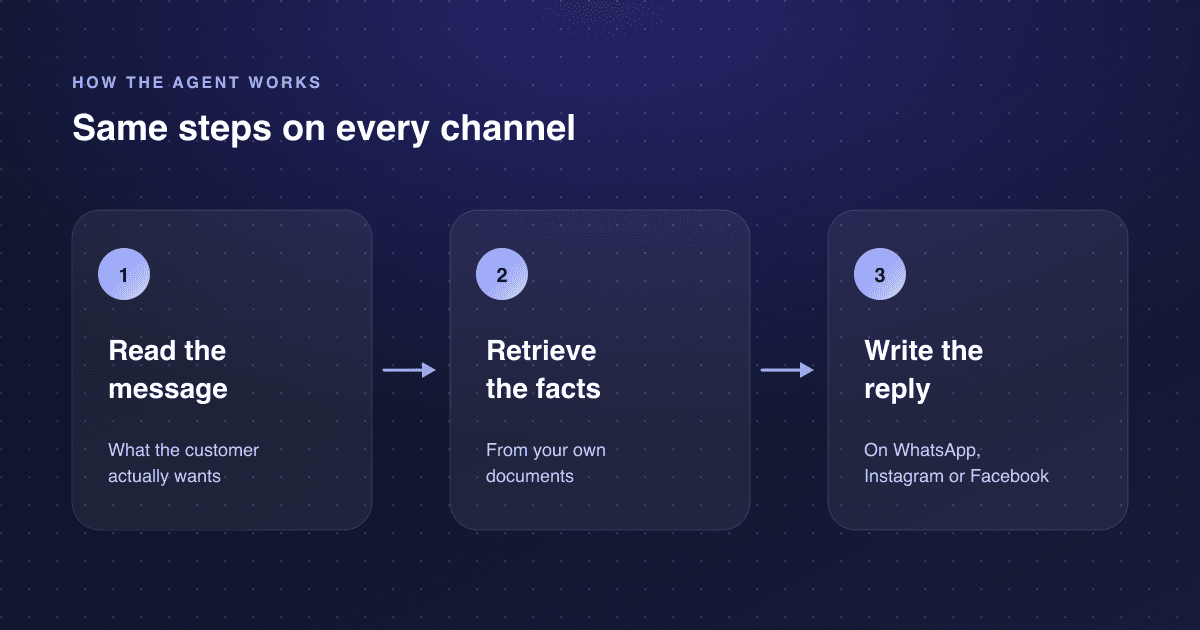
An AI chat agent is a conversational agent that understands messages as language, not as keywords. It works out what the person wants, retrieves the relevant fact from your business data, and writes a reply in the same conversation. The same question about the blue size 42 gets answered as one message, because the agent understood it as one message.
The key mechanism is retrieval: before answering, the agent searches your uploaded documents — product catalogue, FAQs, policies, price lists — and answers from what it finds. That technique is called RAG, and it is what stops the agent from inventing a return policy rather than admitting it does not know yours.
An AI chat agent lives in a chat channel: your website, WhatsApp, Facebook Messenger, Instagram DMs. Its job is the conversation itself — answering, qualifying, selling, supporting — and it hands over to a human when it should.
What is an AI agent?
An AI agent is the broader category. It is software that pursues a goal with some degree of autonomy: it perceives its environment, decides what to do, takes actions, and adjusts based on what happens. An AI chat agent is one kind of AI agent — the conversational kind. Other AI agents never talk to a customer at all: they triage support tickets, reconcile data, monitor systems, or run multi-step workflows across your tools.
The distinction that matters in practice: a chat agent's goal is a good conversation. An AI agent's goal can be anything — including conversations, but also booking, ordering, updating your CRM, or triggering the next step in a process without a human in the loop.
For the full picture of what agents can do beyond chat, see What are AI agents?.
Side-by-side comparison
- Understanding: chatbot matches keywords and menus; AI chat agent understands intent, typos, slang and mixed languages; AI agent (general) understands intent and can act on it across tools, not just in chat.
- Answers: chatbot answers from a script someone wrote; AI chat agent answers from your business data; AI agent answers from your data and can also take actions — booking, ordering, updating records.
- When it fails: chatbot dead-ends or loops; AI chat agent says it does not know and hands over to a human with the thread attached; AI agent routes the exception to a person or a fallback workflow.
- When your business changes: chatbot needs rebuilding; AI chat agent needs a document uploaded; AI agent needs a document uploaded and, if the workflow changed, its rules updated.
- Channels: chatbot usually one widget; AI chat agent runs across WhatsApp, Instagram, Facebook and web from one knowledge base; AI agent runs wherever its job is — chat, inbox, back office.
- Setup: chatbot needs a flow designer to draw the tree; AI chat agent needs your business knowledge uploaded; AI agent needs the knowledge plus its action permissions defined.
Why Neksio is an AI agent, not a chatbot
Neksio's agents are AI agents in the full sense, with chat as their main job. They answer from your own knowledge base through retrieval, work across WhatsApp, Facebook, Instagram and TikTok from one set of documents, and hand conversations to a person — through the unified inbox or the Android app — when judgement is needed. They do not follow a decision tree, and they do not need rebuilding when your catalogue changes: you upload a new document and the answers update.
That is also why they run on official APIs — Meta's for WhatsApp, Facebook and Instagram — rather than browser automation that gets accounts banned. The WhatsApp AI agent guide explains the API difference and why it matters.
Which one do you need?
Ask three questions. First, do your customers ask the same five questions, in the same words, forever? Then a chatbot might honestly be enough — but that business barely exists. Second, do your customers message you on WhatsApp, Instagram or Facebook and expect real answers? Then you need an AI chat agent. Third, do you also want the agent to do things — book appointments, create orders, update records — rather than only answer? Then you need an AI agent with actions, which is what Neksio provides.
If booking is the main job, see the AI booking agent guide for how an agent turns a message into a confirmed appointment. For the day-to-day inbox work, the DM agent guide covers how one agent runs your Instagram and WhatsApp DMs.
No card needed. Start with a WhatsApp agent on the Free plan, or compare plans on the pricing page.
常见问题
- What is an AI chat agent?
- An AI chat agent is software that understands chat messages as language, retrieves the answer from your business data, and replies in the same conversation. It handles questions it has never seen before and hands over to a human when it should.
- What is the difference between a chatbot and an AI chat agent?
- A chatbot follows a scripted decision tree of menus and keywords and breaks on unexpected messages. An AI chat agent understands intent, answers from your product data and policies, and passes the thread to a person when it does not know the answer.
- What is the difference between an AI chat agent and an AI agent?
- An AI chat agent is one kind of AI agent — the conversational kind, whose job is the chat itself. An AI agent is the broader category: software that pursues a goal autonomously, which can include conversations but also actions like booking, ordering or updating records.
- Is a chatbot agent the same as an AI agent?
- No — "chatbot agent" is usually marketing language for a chatbot. If it follows a decision tree and matches keywords, it is a chatbot whatever it is called. If it understands language and answers from your data, it is an agent.
- Do AI chat agents make things up?
- They can, if they answer from the language model alone. The fix is retrieval (RAG): the agent searches your documents first and answers from what it finds, and says it does not know when the answer is not in your data.
- Can an AI chat agent hand over to a human?
- Yes — and it should. A good agent says when it does not know, routes sensitive topics to a person, and keeps the full conversation attached so the human picks up without asking the customer to repeat themselves.